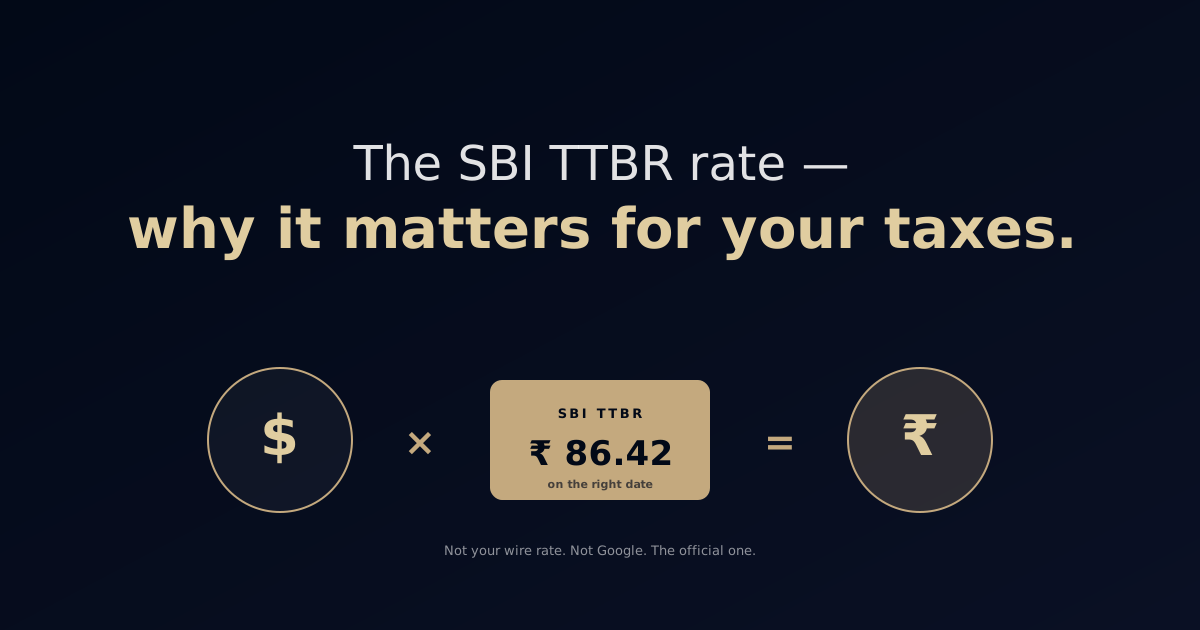
If you hold RSUs from a US company and you're an Indian resident, every tax calculation involving those shares requires a currency conversion. The exchange rate you use is not the rate your bank gave you. It's not the Google exchange rate. It's not even the RBI reference rate.
It's the SBI Telegraphic Transfer Buying Rate — the TTBR — and using the wrong rate is a filing error with real consequences.
What the Sbi Ttbr is
The Telegraphic Transfer Buying Rate is the rate at which the State Bank of India agrees to buy foreign currency from a remitter (someone sending foreign currency to India). It's published daily and historically archived.
The Indian Income Tax Rules specifically mandate the use of SBI TTBR for converting foreign currency income and assets to INR for tax purposes. This is not optional — it's Rule 26 (for the perquisite calculation) and Rule 115 (for capital gains) of the Income Tax Rules, 1962.
Source: Rule 26, Income Tax Rules: https://incometaxindia.gov.in/rules/income-tax-rules.htm Source: Rule 115, Income Tax Rules: https://incometaxindia.gov.in/rules/income-tax-rules.htm
Which Date's Rate to Use — and When
This is where most people get it wrong.
For the perquisite calculation (Tax Event 1 — vest): Use the SBI TTBR rate for the vest date itself. If shares vest on October 15, 2025, use the TTBR rate published for October 15, 2025.
For the capital gains calculation (Tax Event 2 — sale): Use the SBI TTBR rate for the last day of the month preceding the month in which the capital gain occurred. If you sold shares on May 15, 2025, use the TTBR rate for April 30, 2025.
This asymmetry is built into the rules. For perquisite, you use the actual date. For capital gains, you use the last day of the prior month. Mixing these up creates errors in both directions.
📊 TABLE: "Which TTBR Date to Use" [Insert here: 3-column table] Tax event | Rule | Example RSU vest (perquisite) | TTBR on the vest date | Vest on Oct 15 → use Oct 15 TTBR Capital gains on sale | TTBR on last day of prior month | Sale on May 15 → use April 30 TTBR Schedule FA peak value | Approximate using month-end TTBR for the peak month | Peak in August → use July 31 TTBR (or August 31, CAs may differ)
Where to Find Historical Ttbr Rates
SBI publishes daily TTBR rates on its forex services page: https://www.sbi.co.in/web/nri/forex-services
For historical rates, the tool at eximin.net is widely used by CAs and allows you to look up any past date: https://eximin.net
For a specific financial year, you'll want rates for: - Each vest date (for perquisite income) - The last day of each month in which you made a sale (for capital gains)
Why the Ttbr Differs From Your Bank's Rate
When you wire money from your US brokerage account to your Indian bank, your bank applies its own buying rate, which includes a spread (their margin). The rate you actually received is typically 0.5–1.5% lower than the SBI TTBR.
For tax purposes, you must still use the SBI TTBR — not the rate your bank gave you.
This means your tax income (in INR) is calculated on a slightly higher number than you actually received. This is by design — the TTBR is a standardised, publicly verifiable rate, not subject to individual bank negotiations.
A Worked Example
100 Google shares vest on March 15, 2025. Stock closing price: $172.50 SBI TTBR for March 15, 2025: let's say ₹86.40
Perquisite value = 100 × $172.50 × ₹86.40 = ₹14,90,400
This ₹14,90,400 is added to your taxable salary for FY 2024–25. Your employer uses this same rate for their TDS calculation and Form 16 Part B.
Three months later, you sell 70 shares on June 20, 2025, at $181. SBI TTBR for May 31, 2025 (last day of prior month): let's say ₹86.80
Sale value per share (INR) = $181 × ₹86.80 = ₹15,710.80 Cost basis per share (INR) = $172.50 × ₹86.40 = ₹14,904 (from vest day) Capital gain per share = ₹15,710.80 − ₹14,904 = ₹806.80 Total gain (70 shares) = ₹56,476
Note: Different TTBR rates are used for the two calculations (March 15 rate for cost basis, May 31 rate for sale).
How Rovia Can Help
Getting the TTBR right for every vest date and sale date across a year of multiple transactions is tedious but important. Rovia handles this as part of our tax support — pulling the correct rates for each event, building the capital gains schedule, and making sure the ITR reflects the legally correct conversion.