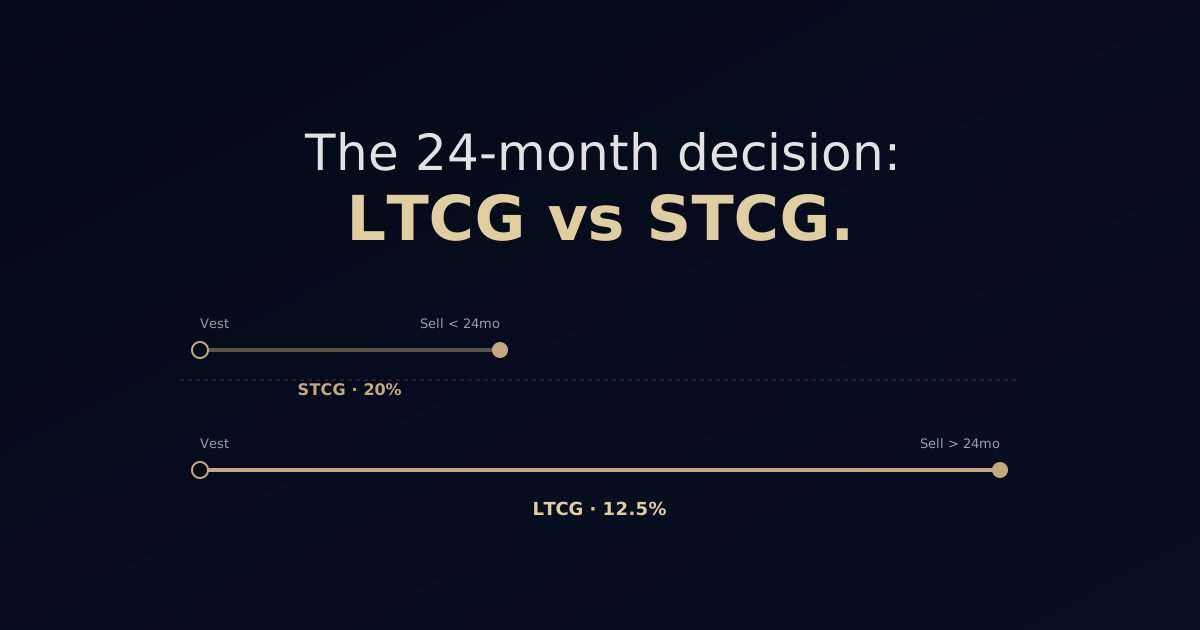
Every time you look at vested shares in your brokerage account, there's a clock running. A 24-month clock from the vest date, counting toward the moment when selling becomes significantly cheaper from a tax perspective.
Most people know this threshold exists. Fewer understand how income bracket, surcharge, and position size all affect the actual rupee difference — and when waiting is genuinely worth the risk.
The Rates (as of April 2026)
For US-listed shares held by an Indian resident:
Short-Term Capital Gains (STCG)
Applies if you sell within 24 months of the vest date. Taxed at your applicable income-tax slab rate — not a flat rate. Under the New Tax Regime (default from FY 2025-26):
| Total Income | Slab Rate |
|---|---|
| Up to ₹4 lakh | Nil |
| ₹4L – ₹8L | 5% |
| ₹8L – ₹12L | 10% |
| ₹12L – ₹16L | 15% |
| ₹16L – ₹20L | 20% |
| ₹20L – ₹24L | 25% |
| Above ₹24L | 30% |
Surcharge (10%–37% of tax, depending on total income) and 4% Health and Education Cess apply on top of the slab rate. For most senior tech employees whose combined salary and RSU perquisite income exceeds ₹24L — which is most readers of this article — the effective STCG rate after surcharge and cess is 31% or higher, reaching 35.88% for income between ₹1Cr and ₹2Cr.
No exemption. No deduction.
Long-Term Capital Gains (LTCG)
Applies if you sell after 24 months from the vest date. The base rate is 12.5% under Section 112. Surcharge and 4% cess apply here too — the effective rate depends on your total income:
| Total Annual Income | Surcharge | Effective LTCG Rate (incl. 4% cess) |
|---|---|---|
| Up to ₹50 lakh | Nil | 13.0% |
| ₹50L – ₹1Cr | 10% | 14.3% |
| ₹1Cr – ₹2Cr | 15% | 14.95% |
| ₹2Cr – ₹5Cr | 25% | 16.25% |
| Above ₹5Cr | 37% | 17.82% |
No exemption applies to US-listed shares. The ₹1.25 lakh annual LTCG exemption (Section 112A) covers only Indian-listed equity and equity mutual funds — not foreign shares. Your full gain is taxable.
What Budget 2024 Changed (effective July 23, 2024)
For foreign shares, the LTCG rate changed from 20% with indexation benefit to 12.5% without indexation. For most holders whose stock has appreciated meaningfully in US dollar terms, this is a rate reduction. However, holders whose gains are primarily driven by rupee depreciation — where the stock is flat or falling in USD terms but shows a rupee gain due to currency movement — may have fared better under the old indexation regime.
STCG on foreign shares was not affected by Budget 2024. It has always been, and remains, taxable at the individual's income slab rate.
Note: For Indian-listed shares (Zomato, Swiggy on NSE/BSE), the LTCG holding threshold is 12 months, not 24. US-listed companies — including Freshworks (NASDAQ: FRSH) — follow the 24-month rule.
Source: Finance Act 2024: https://indiabudget.gov.in/doc/Finance_Bill_2024.pdf
The Real Rupee Difference
Let's run the numbers on a realistic scenario.
You have 300 shares that vested at $160 (≈ ₹13,360/share at TTBR of ₹83.5). Current price: $185 (≈ ₹15,466/share at TTBR of ₹83.6).
Under Section 49(2AA) of the Income Tax Act, the cost of acquisition for capital gains purposes is the FMV at vesting — the same figure already taxed as a salary perquisite. The grant price (typically zero for RSUs) is not your cost basis.
Capital gain per share: ₹15,466 − ₹13,360 = ₹2,106 Total gain on 300 shares: ₹6,31,800
For a senior tech employee with total annual income between ₹1Cr and ₹2Cr (15% surcharge applies):
| Tax Scenario | Effective Rate (15% surcharge + 4% cess) | Tax Paid | Saving vs LTCG |
|---|---|---|---|
| STCG (30% slab) | 35.88% | ₹2,26,650 | ₹1,32,200 |
| LTCG (Section 112) | 14.95% | ₹94,450 | — |
Waiting past 24 months saves over ₹1.32 lakh in this scenario. For senior employees with multiple vesting lots and larger positions, the saving scales into multiple lakhs.
Your actual figures will vary by income bracket — those with income below ₹1Cr will see a smaller saving; those above ₹2Cr will see a larger one. One thing to watch: total income for surcharge purposes includes both your salary and RSU perquisite value. A year with a large vest and a large sale can push you into a higher surcharge bracket than your base salary alone would suggest, affecting both your STCG and LTCG effective rates.
When Waiting Isn't Worth It
The LTCG calculation above assumes the stock holds its value until you cross 24 months. It won't always.
Using the same example — ₹1Cr–₹2Cr income bracket, effective LTCG rate 14.95%, effective STCG rate 35.88% — the stock only needs to fall approximately 3.4% from today's price to eliminate the entire ₹1.32 lakh tax saving.
This 3.4% figure is specific to this example, where the unrealised gain represents about 13.6% of the current position value. If your gain is a larger fraction of current value — say, a stock that has doubled since vest — your break-even decline is meaningfully higher and the margin of safety is wider. If the gain is a small fraction of today's price, the break-even is even narrower than 3.4%.
What this means practically: a 3–4% move in a stock is not unusual over any given quarter. Over 24 months, the range of possible outcomes is considerably wider. The hold-for-LTCG decision is a genuine investment call, not a tax optimisation that works unconditionally.
The question is not "should I wait for LTCG?" in isolation. The question is: "Is this stock stable or growing enough that a 3–5% decline is unlikely over the next 24 months?"
That's an investment judgment, not a tax judgment. Don't confuse them.
How to Track the 24-month Clock Across Lots
Every vest creates a new lot with its own 24-month clock. If you vest quarterly, you have four clocks per year. After four years, you might have 15–20 active lots, each at different stages.
The practical approach:
- In your brokerage platform, look at the Tax Lots section.
- For each lot, note the vest date.
- Calculate 24 months from that date — that's when it becomes LTCG-eligible.
- Build a simple calendar or spreadsheet showing which lots cross the threshold in which month.
- Prioritise selling LTCG-eligible lots first when you do sell.
The ₹1.25 Lakh LTCG Exemption: Why It Doesn't Apply to Your US RSUs
This is one of the most common misconceptions among Indian RSU holders.
The ₹1.25 lakh annual LTCG exemption does not apply to US-listed RSU shares.
That exemption lives in Section 112A, which covers only:
- ✓Equity shares listed on a recognised Indian stock exchange (NSE/BSE)
- ✓Units of equity-oriented mutual funds
- ✓Units of a business trust
US-listed shares — Alphabet, Meta, Microsoft, or any NASDAQ/NYSE-listed stock — are taxed under Section 112, not Section 112A. There is no threshold or exemption. Your full LTCG is taxed at 12.5% plus surcharge and cess as shown in the table above.
If you also hold Indian mutual funds or Indian-listed equity, the ₹1.25 lakh exemption applies to gains on those assets. It simply does not help on the US RSU side.
Advance Tax When a Large LTCG Event Hits
If you sell a large lot and generate significant capital gains, you may need to pay advance tax on that gain in quarterly instalments — not just at filing. Failing to do so attracts interest under Sections 234B and 234C.
Capital gains arising after the last advance tax instalment date (March 15) can be settled in that final instalment without 234C interest. But if you have a large sale in, say, September, you're expected to include those gains in the December instalment.
This is a common surprise for people who make their first large RSU sale. Plan for it.
How Rovia Can Help
Rovia shows you your full lot picture — which lots are LTCG-eligible today, which cross the threshold in the next 3–6 months, and what the actual tax saving looks like for your specific income bracket. From there, we help you build a sell plan that maximises LTCG treatment without unnecessarily concentrating your exposure.
Source: Budget 2024 capital gains changes: https://indiabudget.gov.in Source: Section 112, Income Tax Act — Capital gains on assets other than those covered under Sections 111A and 112A (including foreign listed shares): https://incometaxindia.gov.in