If you received an RSU grant while working in another country — the US, Singapore, Germany, anywhere — and you've since moved to India, the taxation of those RSUs becomes more complicated than the standard two-event framework.
The complication is called source taxation: each country claims a right to tax the income that was earned while you were working within its borders. For RSUs, this is determined by a concept called workday apportionment.
The Basic Principle
An RSU typically vests over several years. During the vesting period, you may have worked in more than one country. The question is: which country has the right to tax the income?
The answer depends on where you were working during each day of the vesting period.
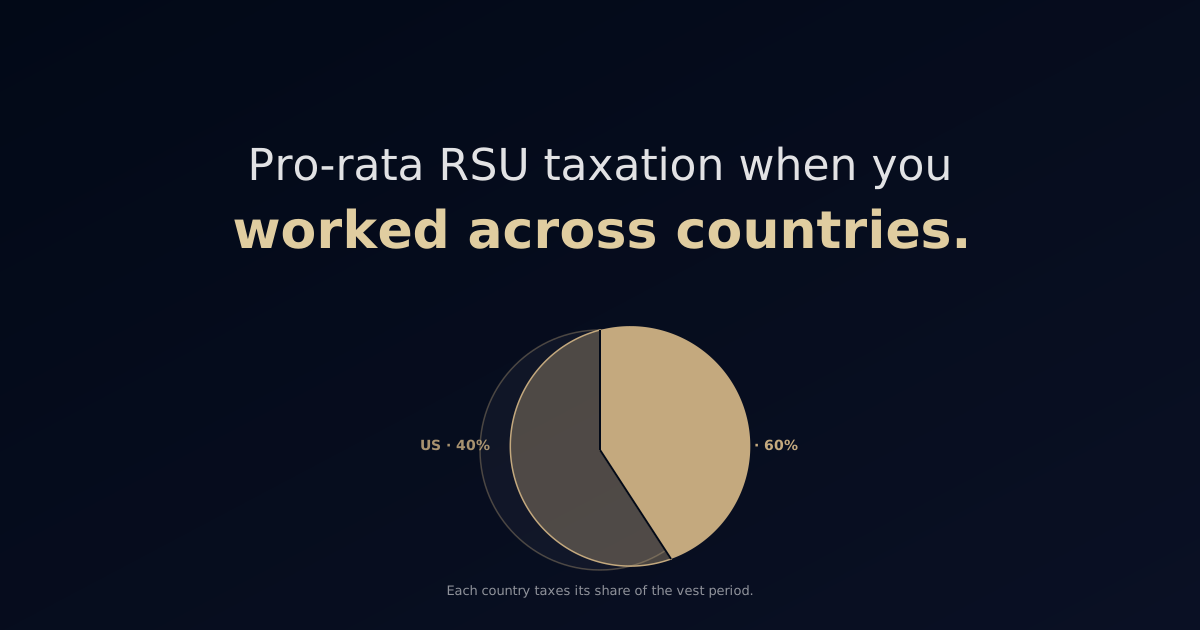
The formula: Perquisite to be taxed in Country A = Total perquisite × (Days worked in Country A during vesting period ÷ Total days in vesting period)
This is the pro-rata calculation. It apportions the perquisite between countries based on where you actually worked.
An Example
You receive an RSU grant on January 1, 2023, while working in the US. The grant vests on January 1, 2025 — a two-year vesting period. In mid-2024, you move to India and continue working from Bangalore.
During the 24-month vesting period: - 18 months worked in the US (720 working days) - 6 months worked in India (120 working days × you can approximate) - Total: let's say 840 working days
Pro-rata: 720/840 = 85.7% attributable to the US; 120/840 = 14.3% attributable to India.
If the total perquisite at vest is $100,000: - $85,700 should be taxed in the US - $14,300 should be taxed in India
In practice, if the employer doesn't apply this apportionment correctly, both countries may try to tax the full $100,000 — creating genuine double taxation.
How India Treats the India-portion
The India-attributable portion of the RSU perquisite is taxed as salary income in India, at your applicable slab rate. Your Indian employer (or the Indian subsidiary of the US company) should deduct TDS on the India-attributed amount.
The US-portion is taxed in the US, typically as W-2 income (for employees who were on US payroll during that period).
Claiming Foreign Tax Credit for the Us Portion
If both countries end up taxing the same income (because the apportionment wasn't applied, or was applied differently), the DTAA mechanism kicks in:
File Form 67 in India, claiming a Foreign Tax Credit for the US tax paid on the income that's also taxable in India. The FTC reduces your Indian tax on that income.
This requires documentation: your US W-2 for the relevant year, your US tax return (if filed), and evidence of the tax paid in the US.
The Documentation You Need
If you worked across countries during any RSU vesting period, gather: 1. Your employment contracts for each country (confirming dates of employment) 2. Payslips or W-2/P60 equivalents from each country for the vesting period 3. Travel and work records (if you divided time between countries, day-level records are helpful) 4. Your employer's equity grant letter and vesting schedule
Without this documentation, you can't prove the apportionment, and you're at risk of either over-paying tax in India or being unable to claim the FTC you're entitled to.
A Specific Situation: Returning Nri
If you worked in the US for 3–4 years and then moved back to India mid-vesting period, your situation involves: - RSU grants made when you were a US employee: partially attributable to the US (for the time you worked there), partially to India (after you moved) - Potentially different tax residency status in your first year back (RNOR — Resident but Not Ordinarily Resident — which has its own rules)
RNOR status provides a limited shield: income from a foreign source that doesn't derive from a business controlled in India is not taxable for RNOR individuals. This can affect RSUs vested during the RNOR period, depending on specifics.
This is complex enough that it deserves its own professional review — ideally before you file, not after.
How Rovia Can Help
Cross-country RSU taxation is one of the more intricate areas of equity planning. Rovia works with clients who have RSU histories across multiple countries and helps them build the correct apportionment, claim the right credits, and file without overpaying.
Source: India–US DTAA, Article 15 (dependent personal services): https://incometaxindia.gov.in/treaties/india-usa.pdf Source: Rule 26A — split salary perquisite apportionment: https://incometaxindia.gov.in/rules/income-tax-rules.htm