This is a short post about a short form that has significant consequences if you haven't submitted it.
If you're an Indian resident holding shares in a US brokerage account, W-8BEN tells the broker that you are not a US tax resident. Without it, your broker may withhold US taxes from your proceeds — sometimes as much as 30%. Getting it back requires filing with the IRS, which most Indian employees have no infrastructure to do.
What W-8ben is
Form W-8BEN (Certificate of Foreign Status of Beneficial Owner for United States Tax Withholding and Reporting) is an IRS form that certifies you are a non-US resident for tax purposes.
By submitting it, you're telling your broker: "I am not a US person. Do not apply US withholding taxes to my income."
Source: IRS Form W-8BEN: https://www.irs.gov/forms-pubs/about-form-w-8-ben
What it Covers and What it Doesn't
W-8BEN covers capital gains from selling US-listed shares: As an Indian resident, you are generally not subject to US capital gains tax when you sell shares. W-8BEN confirms this non-resident status.
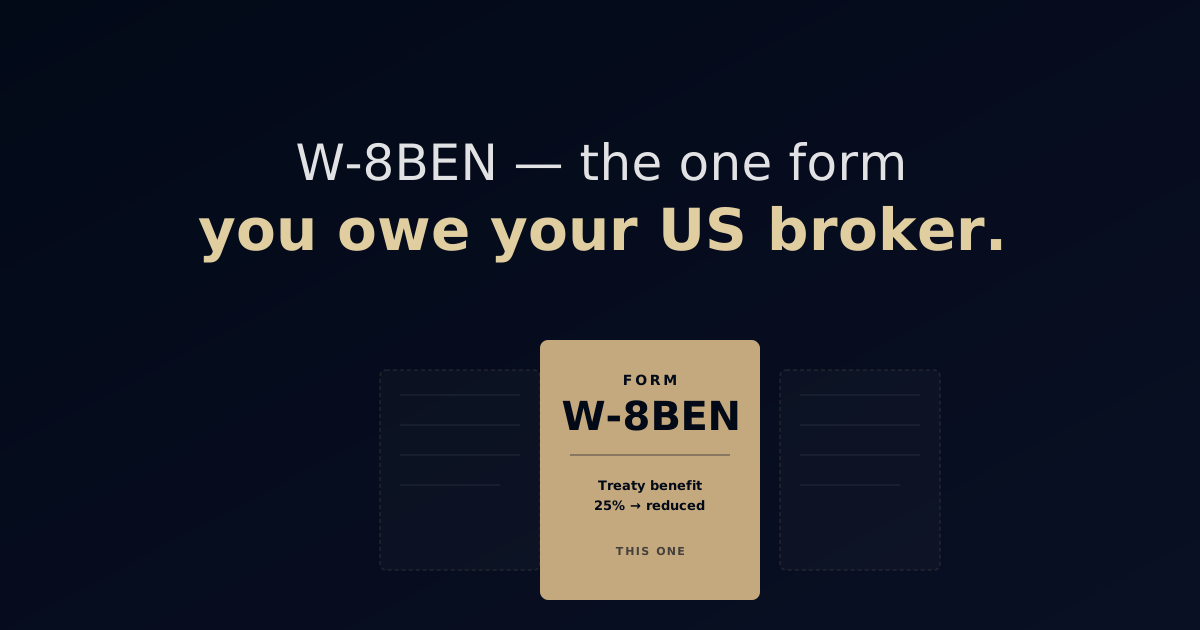
W-8BEN does NOT cover dividends: The US imposes a withholding tax on dividends paid to non-residents. The standard rate is 30%, but the India–US DTAA reduces this to 25% for Indian residents who have submitted W-8BEN. You'll still pay 25% withholding on dividends — but 25% is better than 30%.
What Happens Without it
Without W-8BEN, some brokers apply backup withholding at 24–30% on certain payments. The precise treatment depends on the broker and the transaction type, but the risk is real: a portion of your sale proceeds or dividends withheld by the broker and sent to the IRS.
Recovering this requires filing a US tax return (Form 1040-NR) and claiming a refund — a process that most Indian residents are not set up for and that involves hiring a US tax professional.
Preventing this entirely takes five minutes: submit W-8BEN.
How to Submit W-8ben
For Charles Schwab: Log in → Account Summary → Profile → Tax Certification → W-8BEN update
For Fidelity: Log in → Profile → Personal Information → Tax Certification
For E*TRADE / Morgan Stanley: Log in → Account Settings → Tax Certification → Foreign Tax Certification
The process is online for all major brokerages. You'll confirm your: - Name - Country of citizenship and residence (India) - Permanent address - Tax Identification Number (your Indian PAN) - DTAA claim (check the box for India–US treaty)
W-8ben Expires After Three Years
This is the detail people most often forget.
W-8BEN is valid for three calendar years from the year it was signed. If you submitted it in March 2022, it expired at the end of 2024. Your broker should send you a reminder when it's about to expire, but don't count on it.
Set a calendar reminder: check your W-8BEN status every three years, or when you receive a renewal notice from your broker.
Dividends: the Piece That Still Has Withholding
Even with W-8BEN, the US withholds 25% on dividends from US-listed shares under the DTAA. This money doesn't disappear — you can claim it as a Foreign Tax Credit against your Indian income tax liability.
To claim the FTC, file Form 67 (the Indian form for claiming foreign tax credit) before you file your ITR. The credit reduces your Indian tax liability by the amount of US tax withheld on the dividend.
Don't skip Form 67 — the credit goes unclaimed if you don't file it, and that's money left on the table.
How Rovia Can Help
Part of Rovia's onboarding process for new clients is confirming that W-8BEN is in place. It's a small but important compliance step that protects you from unnecessary withholding. If yours has lapsed, we'll walk you through the renewal.
Source: India–US DTAA, Article 10 (dividends): https://incometaxindia.gov.in/treaties/india-usa.pdf Source: IRS W-8BEN instructions: https://www.irs.gov/pub/irs-pdf/iw8ben.pdf