When a stock falls below the price at which your RSUs vested, something counterintuitive happens: you end up with a tax asset.
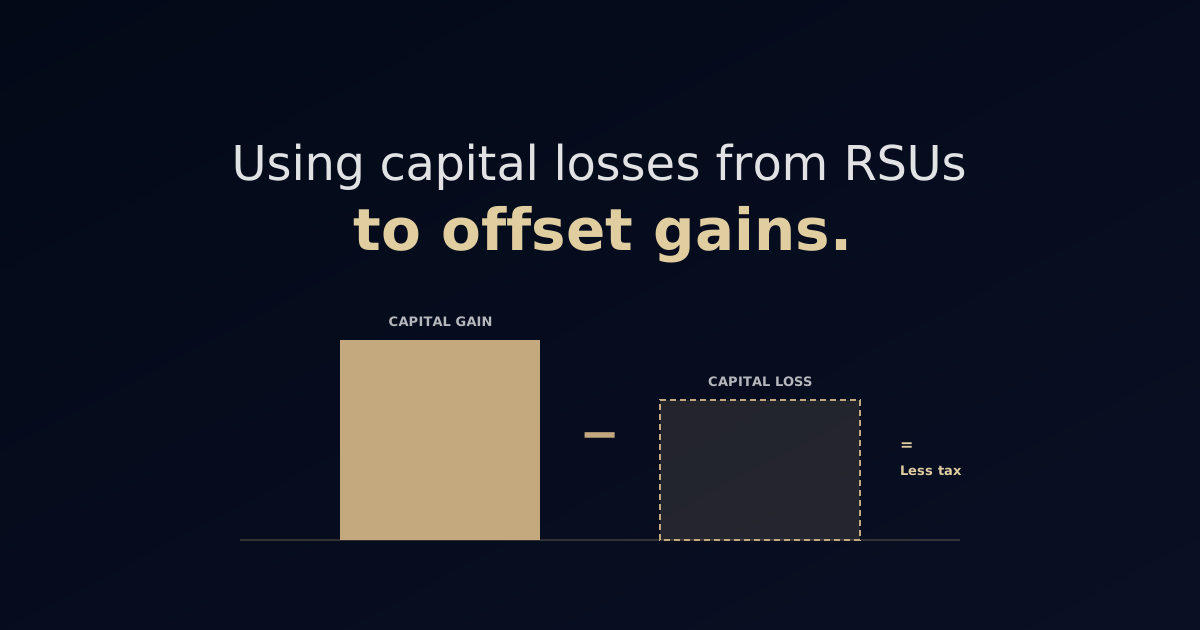
Most people look at underwater RSU shares — shares worth less than what they were taxed on — and see only loss. But those shares carry a capital loss that can be used to reduce your tax on other gains. Understanding this turns a disappointing situation into a financial tool.
How a Capital Loss is Created From Rsus
When your RSUs vest, the FMV on vest day becomes your cost of acquisition. If the stock subsequently falls below that FMV, and you sell at the lower price, the difference is a capital loss.
Example: 100 shares vest at $185 (≈ ₹15,910/share). Stock falls to $140. You sell at $140 (≈ ₹12,040/share, assuming TTBR unchanged for simplicity).
Capital loss per share = ₹12,040 − ₹15,910 = −₹3,870 Total capital loss = 100 × ₹3,870 = ₹3,87,000
This loss is real, reportable, and usable — even though you already paid income tax on the full ₹15,910/share at vest.
This is one of the harder pills to swallow about RSU taxation: you paid income tax at vest on a value you never realised. If the stock falls, you paid tax on phantom income. The capital loss partially compensates for this — but it doesn't recover the perquisite tax you paid.
What You Can Do With a Capital Loss
Set-off in the same year: Short-term capital losses (from shares held less than 24 months) can be set off against both short-term and long-term capital gains. If you have ₹3.87 lakh in short-term capital losses and ₹3 lakh in short-term capital gains (from other RSU sales), the losses wipe out the gains — zero tax on that ₹3 lakh.
Long-term capital losses (shares held more than 24 months) can only be set off against long-term capital gains. They cannot reduce short-term capital gains.
Carry forward: If losses exceed gains in a year, or if you have no gains to offset, the loss can be carried forward for up to eight financial years. You can use it against future capital gains as they arise.
You must file your ITR on time (by the due date) in the year of the loss to be eligible to carry it forward. If you file late, the carry-forward benefit is lost.
📊 TABLE: "Capital Loss Set-Off Rules" [Insert here: table] Type of loss | Can offset | Cannot offset Short-term capital loss | Short-term capital gains + Long-term capital gains | Salary, business income Long-term capital loss | Long-term capital gains only | Short-term capital gains, salary, business income
Strategic Harvesting: When to Realise the Loss
Tax-loss harvesting means deliberately selling underwater lots to realise a loss, specifically to offset gains elsewhere.
When this makes sense: - You have other RSU lots in the same year that you're selling at a gain (STCG or LTCG) - You want to bring the net gain below ₹1.25 lakh to maximise the LTCG exemption - You have large capital gains from other assets (mutual funds, other stocks) that you want to reduce
When it's less clear: - The stock might recover, and you'd be selling at the trough - The loss is small relative to transaction costs (brokerage, STT)
The decision is always: is the tax saving from harvesting this loss worth more than the potential recovery if you hold?
How it Appears in Your Itr
Capital losses are reported in Schedule CG of your ITR-2 or ITR-3. The schedule has separate sections for short-term and long-term gains/losses. Your CA will enter each transaction with its cost basis, sale price, and holding period — and the schedule automatically calculates the net gain/loss for set-off and carry-forward.
The carry-forward amount appears in Schedule CYLA (Current Year Loss Adjustment) and Schedule BFLA (Brought Forward Loss Adjustment) — these are the tracking registers the tax system uses to account for loss carry-forwards across years.
THE MISCONCEPTION ABOUT "DOUBLE TAXATION"
A common frustration: "I paid 30% income tax when shares vested at $185, and now the stock is at $140. I'm being taxed on money I never made."
This is true — and it's unfair in a colloquial sense. But the capital loss mechanism is the partial remedy: selling at $140 creates a deductible capital loss that you can use now or carry forward. It doesn't recover the perquisite tax, but it reduces future tax.
How Rovia Can Help
Rovia will identify your underwater lots — shares where the current price is below the vest-day FMV — and help you calculate the capital loss available for harvesting. We'll also model how that loss interacts with your planned sales to show you the net tax impact.
Source: Section 74, Income Tax Act — carry-forward of capital losses: https://incometaxindia.gov.in