India's income tax isn't just a flat rate applied to your taxable income. Above certain income levels, a surcharge is levied on the tax itself — and this surcharge can meaningfully increase your effective tax rate in a way most RSU holders don't plan for.
For senior tech employees where RSU perquisite income is large, crossing a surcharge threshold can add several lakh rupees in additional tax — sometimes crossing it by just a small margin.
How Surcharge Works
Surcharge is a tax on the tax. If your total income exceeds certain thresholds, your income tax liability goes up by a percentage.
Current surcharge rates (FY 2025–26): Total income between ₹50L–₹1Cr: 10% surcharge on income tax Total income between ₹1Cr–₹2Cr: 15% surcharge Total income between ₹2Cr–₹5Cr: 25% surcharge Total income above ₹5Cr: 37% surcharge (for old regime; 25% under new regime)
Plus 4% Health and Education Cess on top of income tax + surcharge.
At the 30% slab with a 15% surcharge, the effective rate is 30% × 1.15 × 1.04 = 35.88%.
Source: Income Tax slabs and surcharge rates FY 2025–26: https://incometaxindia.gov.in
How Rsus Push You Over Thresholds
The perquisite income from RSU vests is treated as salary. It's added to your total income alongside your regular salary.
A hypothetical example: Regular salary (CTC minus RSU): ₹35,00,000 RSU perquisite (large vest in Q3): ₹22,00,000 Total income: ₹57,00,000
This person has crossed the ₹50 lakh threshold into the 10% surcharge band, and they might not have been expecting to — because in a year with a smaller vest, they were below it.
The additional surcharge cost: 10% on the income tax on the amount above ₹50L. This can add ₹1–3 lakh to the tax bill depending on the numbers.
The Marginal Rate Cliff
The surcharge creates a cliff effect at each threshold. Moving from ₹49.9 lakh to ₹50.1 lakh in income means a significant jump in effective tax rate — not just on the additional ₹20,000 but on the total tax.
India has a "marginal relief" provision that prevents this cliff from being completely punitive — if the additional tax on crossing the threshold exceeds the income above the threshold, the surcharge is capped. But this only helps near the exact crossing point.
For most RSU holders, the practical implication is: be aware of which threshold you're near, and see if there are timing adjustments available.
What You Can Control
The vest date is fixed — you can't move it. The perquisite income from vests is not avoidable.
What you can influence: - Timing of RSU share sales: Capital gains from sales you initiate are under your control. If your perquisite income from vests is already pushing you toward a threshold, consider deferring discretionary sales to the next financial year. - Spreading large LTCG realisations across years: If you have large LTCG lots ready to sell, selling half in March and half in April keeps the gains in different financial years, potentially keeping you below a threshold in each. - Contribution to eligible deductions: NPS contributions, insurance premiums, and other 80C/80D deductions reduce taxable income and can pull you back below a threshold.
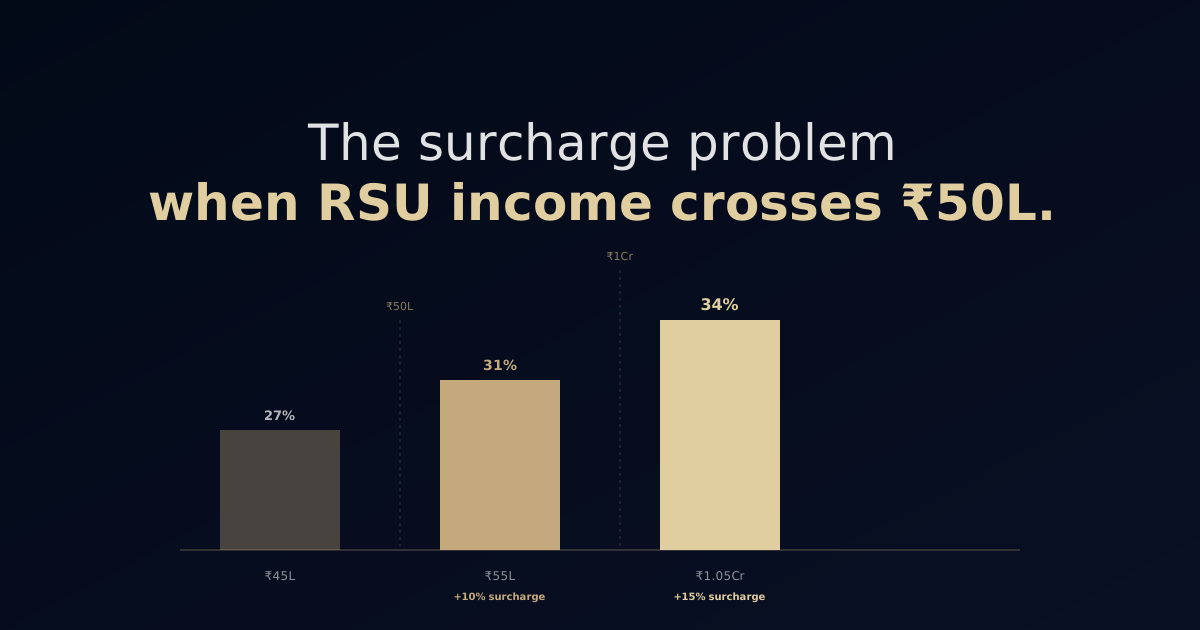
📊 TABLE: "Effective Tax Rates at Different Income Levels" [Insert here: table] Total income | Income tax (30%) | Surcharge | Cess | Effective rate (approx.) ₹45,00,000 | ₹12,00,000 | Nil | ₹48,000 | ~27% ₹55,00,000 | ₹15,00,000 | ₹1,50,000 (10%) | ₹66,000 | ~31% ₹105,00,000 | ₹30,00,000 | ₹4,50,000 (15%) | ₹1,38,000 | ~34% Note: Simplified illustration. Actual calculation depends on deductions and specific income composition.
The Interaction With Capital Gains
Short-term capital gains (STCG) and long-term capital gains (LTCG) are added to total income for the purpose of calculating surcharge thresholds.
However: the surcharge on LTCG is capped at 15%, regardless of which total income bracket you're in. So if crossing the ₹2 crore threshold because of LTCG would have pushed your surcharge to 25%, the LTCG portion of that surcharge is still calculated at 15%.
This cap provides partial relief for people whose total income crosses higher surcharge thresholds primarily because of large LTCG events.
How Rovia Can Help
If you have large vests coming up and you're not sure whether you'll cross a surcharge threshold — or if you're trying to time discretionary sales to stay below one — Rovia can model the full year income picture and identify the optimal timing.
This is an area where a few weeks' difference in a sale date can mean ₹1–2 lakh in tax. Worth running the numbers.