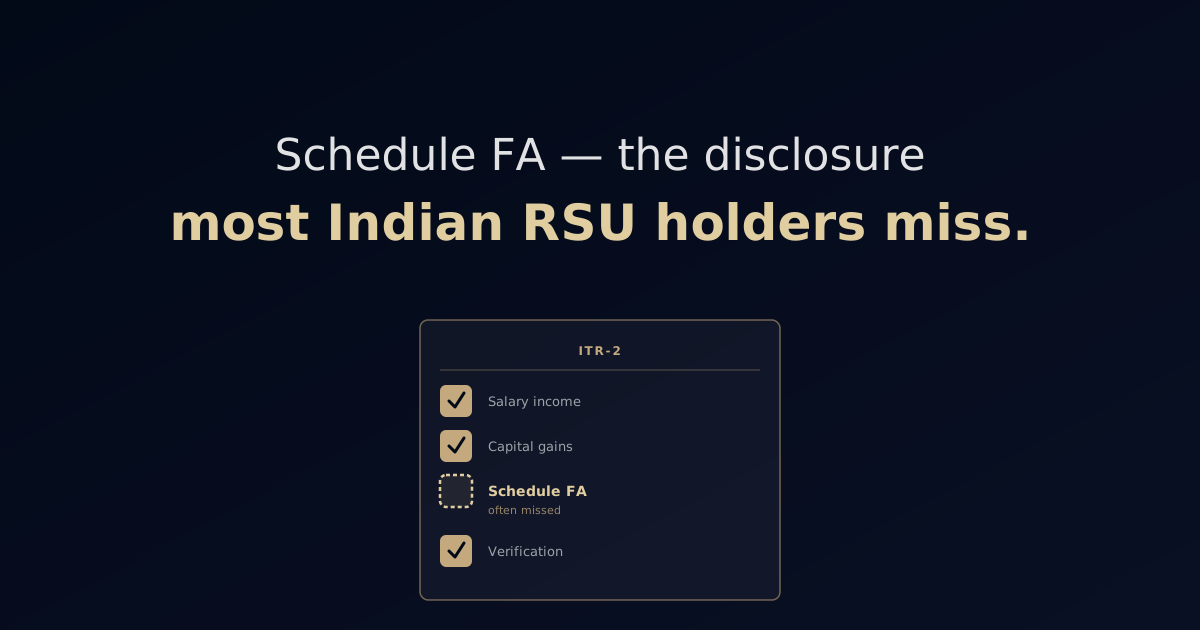
If you hold shares in a US brokerage account and you're filing your Indian income tax return, there's a section you are legally required to complete every year. It's called Schedule FA — the Foreign Assets disclosure.
Most people filing ITR themselves miss it. Many CAs who aren't specialists in foreign equity miss it. The penalties for non-disclosure are severe — disproportionately severe relative to the underlying income or tax involved.
This one gets its own post because it's that important.
What Schedule Fa is
Schedule FA is a section in ITR-2 and ITR-3 that requires Indian resident taxpayers to disclose all foreign assets they held at any point during the calendar year. Not the financial year (April to March). The calendar year (January to December).
This distinction trips people up every year. Your ITR covers April 1 to March 31. Schedule FA covers January 1 to December 31 of the same calendar year. If you hold shares in a Schwab account, you need to report what you held in that account for all of January through December.
Assets that must be disclosed: - Foreign bank accounts (any bank account outside India) - Foreign equity and debt investments (shares in a US brokerage account) - Foreign immovable property (real estate outside India) - Any other foreign financial interest
For RSU holders, the primary disclosure is the Schwab/Fidelity/E*TRADE account and the shares in it.
WHAT "VESTED SHARES" MEANS FOR SCHEDULE FA
A common question: do unvested RSUs need to be disclosed?
No. Unvested RSUs are not assets you own. You have no legal title to them. They do not need to appear in Schedule FA.
Vested shares that you hold in a foreign brokerage account — yes, these must be disclosed. Even if you didn't sell them. Even if you have no plans to sell them. Even if the account has a small balance. If you owned them at any point in the calendar year, they must be disclosed.
The Peak Value Requirement
Schedule FA asks for the "peak value" of foreign assets during the calendar year — the highest value the holding reached at any point during the year, not just the value at year-end.
For a stock that rose from $100 to $170 and then fell back to $130 over the calendar year, the peak value is $170. You report $170, even if year-end value was $130.
How to find this: look at your brokerage statement across the year, note the highest month-end balance (or day-end balance if you have that level of data). Most brokerage platforms have a "portfolio history" or "account value history" section.
The Penalties for Non-disclosure
The Black Money (Undisclosed Foreign Income and Assets) and Imposition of Tax Act, 2015 governs penalties for non-disclosure of foreign assets. The penalties are steep:
- Tax on the value of undisclosed foreign assets: flat 30% - Penalty: up to 3× the tax (i.e., 90% of the asset value) - Criminal prosecution possible in severe cases
To put this in context: if you have $50,000 in a Schwab account and don't disclose it in Schedule FA, the theoretical penalty exposure is 30% × $50,000 (tax) + 90% × $50,000 (penalty) = 120% of the asset value. More than the asset itself.
This is not theoretical. The Income Tax Department has been actively pursuing foreign asset non-disclosures, including under the FATCA (Foreign Account Tax Compliance Act) framework under which US financial institutions share account data with Indian tax authorities.
Source: Black Money Act, 2015: https://incometaxindia.gov.in/acts/black-money-(undisclosed-foreign-income-and-assets)-and-imposition-of-tax-act-2015.pdf Source: FATCA India-US agreement: https://www.irs.gov/businesses/corporations/fatca-agreements
How to Fill Schedule Fa for a Us Brokerage Account
In your ITR (ITR-2 or ITR-3), navigate to Schedule FA. You'll see a table with the following fields for equity and debt investments:
Country: United States Name and address of entity: [Your brokerage — e.g., Charles Schwab & Co., 211 Main St, San Francisco, CA] Nature of investment: Equity shares Date of acquiring: For each lot, the vest date Total investment at cost: Number of shares × FMV on vest date (converted to INR at TTBR) Peak value during the year: Highest INR value of the holding during the calendar year Closing balance: Value at December 31 (converted at TTBR for Dec 31) Total gross amount paid/credited: Any dividends received during the year
If you have multiple vesting lots (which you almost certainly do), you may need to list each one separately or group them by company.
Amending Past Itrs
If you filed ITR-1 in a year you held foreign assets (which is not allowed — foreign asset holders cannot use ITR-1), or if you filed ITR-2/3 but left Schedule FA blank, you can file a revised return within the deadline allowed by the Income Tax Department. If the deadline has passed, you may need to file a belated return or engage with the department directly.
This is worth doing proactively rather than waiting to be flagged.
How Rovia Can Help
Schedule FA is one of the most commonly missed compliance requirements for RSU holders. Rovia will ensure it's filled correctly — including the peak value calculation, the correct calendar year vs financial year distinction, and the accurate INR conversion for each lot.
If you're not sure whether your past returns included Schedule FA, we can help you figure that out and take corrective action.