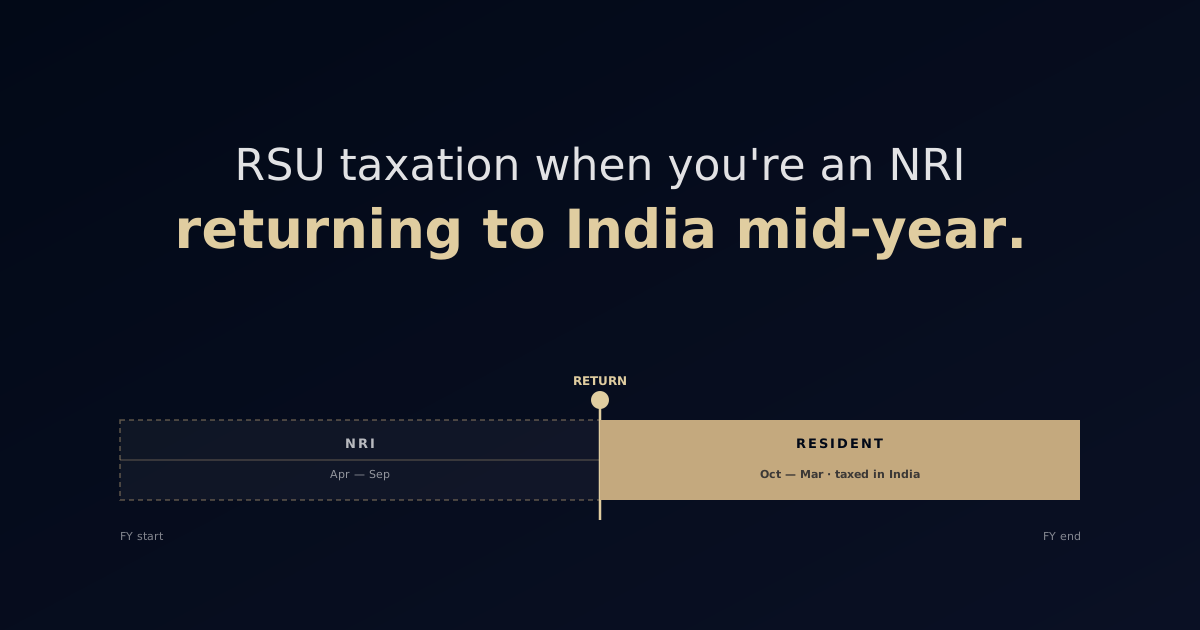
The year you return to India from abroad is, in most cases, the most complicated year you'll have for income tax. Multiple residency statuses, income from multiple countries, RSUs vested in different locations — all of it converges in a single ITR.
Getting it wrong creates problems that take years to unwind. Getting it right requires understanding how India's residency rules work and what changes the moment you cross the threshold.
Residency Status Determines Everything
India's income tax system uses residency status to determine what income is taxable:
Resident and Ordinarily Resident (ROR): Globally taxable. All income from anywhere in the world is taxable in India.
Resident but Not Ordinarily Resident (RNOR): A transitional status. Taxable on Indian-sourced income and income from a business/profession controlled from India. Foreign-sourced income (like RSUs vesting from a foreign employer) may not be taxable in India during this period.
Non-Resident Indian (NRI): Only Indian-sourced income is taxable in India. Foreign income is not.
The key question: which status do you have in the financial year you return?
How Residency is Determined
You are a Resident if you are present in India for: - 182 days or more in the financial year, OR - 60 days or more in the financial year and 365 days or more in the preceding 4 years
RNOR status applies if you are a Resident who: - Was an NRI in 9 of the preceding 10 financial years, OR - Was present in India for 729 days or fewer in the preceding 7 financial years
Most returning NRIs qualify for RNOR status in their first year back (sometimes extending into the second year), giving them a limited period during which foreign income is not taxable in India.
Source: Section 6, Income Tax Act — residency conditions: https://incometaxindia.gov.in
Rsus Vested During Nri Period
If RSUs vested while you were an NRI and working abroad, those vesting events were taxable in the country where you were employed — not in India. India has no claim on that income if you were an NRI at the time.
For capital gains on those shares: once you're back in India as a resident, any capital gains from selling shares (vested during NRI period) become taxable in India. The cost basis is still the FMV on the vest date (wherever you were), and the holding period runs from the vest date.
Rsus Vesting After Return to India
Once you're a resident (even RNOR), RSUs that vest after your return are taxable in India as perquisite income. Your employer in India (or the Indian subsidiary handling your payroll) should deduct TDS.
If you're on an Indian payroll after moving back, this typically happens automatically. If you're still on a foreign payroll during a transition period, you may need to pay the perquisite tax directly through advance tax.
The Rnor Shield
During the RNOR period, income from a foreign source that doesn't derive from a business/profession controlled in India may be exempt from Indian tax.
For RSUs specifically: - RSUs vesting from a foreign company, from a grant made before you became an Indian resident — potentially exempt from Indian income tax during RNOR period. - Capital gains from selling foreign-vested shares during RNOR period — potentially exempt.
"Potentially" is doing a lot of work here. The rules have nuances, and the RNOR benefit is a specific provision that needs to be applied carefully, ideally with a tax professional who has handled returning NRI cases.
The First Filing Year: What to Get Right
1. Determine your residency status precisely (count your days in India for the financial year). 2. Identify which RSU vests occurred while NRI, which during RNOR, which as resident. 3. Determine whether the RNOR exemption applies to any of your RSU income. 4. Start Schedule FA from the year you became a resident — even if you haven't sold anything. 5. Reconcile any US/foreign tax paid on RSU income with Indian tax obligations via Form 67.
How Rovia Can Help
The year of return is when having good professional support pays off most. Rovia has worked with returning NRIs through the transition — from figuring out residency status to mapping which RSU income is taxable where, to making sure the first post-return ITR is filed correctly.
If you're planning to return in the next 12–24 months, starting this conversation early is much better than trying to reconstruct it after the fact.
Source: Circular on RNOR status and foreign income: https://incometaxindia.gov.in Source: India–US DTAA — relief for double taxation: https://incometaxindia.gov.in/treaties/india-usa.pdf