You've sold some RSU shares. There's money sitting in your Schwab account. Now what?
This is the question most people haven't planned for when they finally decide to sell. The answer depends on what you want to do with the proceeds, and each path has different regulatory and tax implications.
Three Paths for Rsu Proceeds
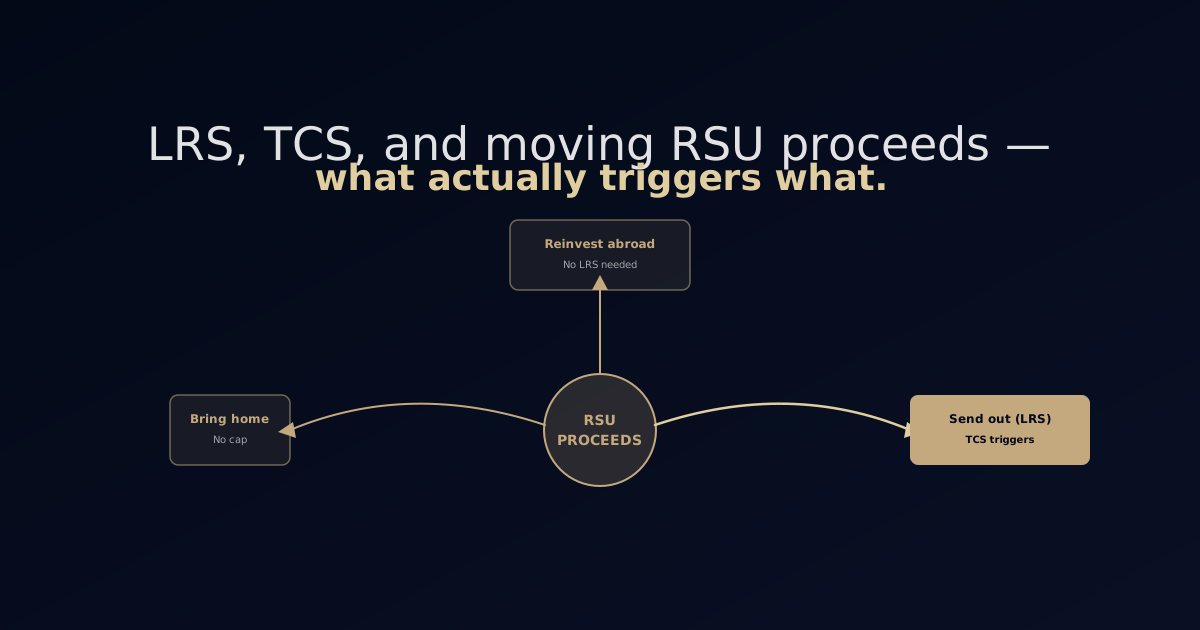
Path 1: Bring the money to India (inward remittance) Path 2: Reinvest abroad in a diversified portfolio (stay in the US brokerage) Path 3: Do nothing — leave it in the brokerage account in cash
Path 1: Bringing Money to India
Inward remittance — moving money from a foreign account to an Indian account — has no regulatory cap. You can bring any amount back to India. The RBI doesn't restrict inflows.
The wire transfer process: Instruct your US brokerage to initiate a wire transfer to your Indian bank account (provide the bank's SWIFT code, IFSC code, and account details). Your bank converts USD to INR at their buying rate and credits your account.
Tax implications: The capital gains on the sale are taxable in India regardless of whether you bring the money back or not. Repatriation itself doesn't trigger additional tax. You report the capital gains in Schedule CG of your ITR based on the sale transaction, not based on when the money hits your Indian account.
One nuance: the exchange rate your bank uses for the wire transfer will differ slightly from the SBI TTBR used for tax calculation. This is normal — you report capital gains using the mandated TTBR rate.
Path 2: Reinvesting Abroad (lrs)
If you want to sell RSU shares and reinvest the proceeds into a diversified ETF portfolio in the same or different US brokerage account, you're generally fine — there's no LRS transaction here because the money stays in the existing foreign account.
LRS becomes relevant when an Indian resident is remitting money from India to a foreign account for investment purposes. If you already have money sitting in a US brokerage, investing it there doesn't require a new LRS remittance.
However, if you want to top up the account with additional money from your Indian savings (to increase your foreign investment), that top-up is an LRS remittance.
The LRS limit: $250,000 per individual per financial year (April–March). This is cumulative across all foreign spending — travel, education, investments, everything.
Source: RBI LRS framework: https://www.rbi.org.in/scripts/FAQs.aspx?Id=1834
Tcs on Lrs Remittances
If you do send money from India to a foreign account under LRS, Tax Collected at Source (TCS) applies.
Current rules (as of April 2026, per Budget 2025): - Threshold: First ₹10 lakh of LRS remittances per year — no TCS. - Above ₹10 lakh: TCS at 20% on the excess amount (for investment-purpose remittances). - For education (with loan): TCS at 0.5% above ₹7 lakh. - For other education/medical: TCS at 5% above ₹7 lakh.
TCS is not an additional tax. It's advance tax collected at source. You claim it back against your total tax liability when filing your ITR. If TCS exceeds your liability, you get a refund.
The cash flow problem: if you remit ₹30 lakh abroad for investment, ₹4 lakh (20% of the ₹20 lakh above the ₹10L threshold) is withheld as TCS. You get it back eventually, but it's locked until your ITR refund is processed — potentially 6–12 months later.
Plan: if you're doing large LRS remittances, do them early in the financial year so the TCS refund arrives sooner.
Source: TCS on LRS — Finance Act 2025: https://indiabudget.gov.in
Path 3: Leaving it in the Brokerage Account
This is technically a valid choice, but it comes with a cost: the cash earns little to no interest in a standard brokerage account. There's no investment return until you invest.
From a compliance standpoint: the cash balance in your foreign brokerage account must be disclosed in Schedule FA, regardless of whether it's invested or sitting in cash.
The Currency Conversion Question
For capital gains tax: use the SBI TTBR for the last day of the month before the sale (regardless of when you actually wire the money to India).
For Schedule FA: use the SBI TTBR for December 31 of the calendar year to convert the year-end balance to INR.
How Rovia Can Help
Rovia works with the entire cross-border money flow — from the sale in your US brokerage, through the reinvestment decision, to what comes to India and what stays abroad. We'll help you optimise the path: which proceeds to repatriate, which to reinvest, and how to do it in a way that's compliant and tax-efficient.
📊 TABLE: "Three Paths for RSU Proceeds — At a Glance" [Insert here: 4-column table] Path | What it involves | Key rule | Tax trigger Bring to India | Wire transfer, USD → INR | No cap on inward remittances | Capital gains tax (already reportable) Reinvest abroad (existing account) | Buy ETFs in same brokerage | No new LRS needed if money already abroad | None (until you sell the new investment) Send new money from India abroad | LRS remittance | $250K annual cap per person | TCS on remittances above ₹10L