Most people sell RSU shares the way they buy things on impulse — quickly, without thinking about which specific units they're actually selling. In most consumer transactions, this doesn't matter. In RSU sales, it can cost you tens of thousands of rupees.
Lot selection is the practice of specifying exactly which shares you're selling when you place a sell order. It's one of the most accessible tax optimisation tools available to any RSU holder, and it's almost entirely ignored.
What a Tax Lot is
Every time RSUs vest, a new tax lot is created. A lot is a group of shares acquired at the same time, at the same cost basis (FMV on vest date).
If you've been vesting quarterly for three years, you might have 12 lots. Each lot has: - A specific number of shares - A specific FMV (cost basis) — the stock price on the vest date, in INR at that day's TTBR - A specific acquisition date (the vest date) - A holding period: how long since the vest date
Different lots will be at different stages of the 24-month LTCG clock. Some will be in gain territory (current price > vest-day FMV). Some might be in loss territory (current price < vest-day FMV).
The Default: Fifo
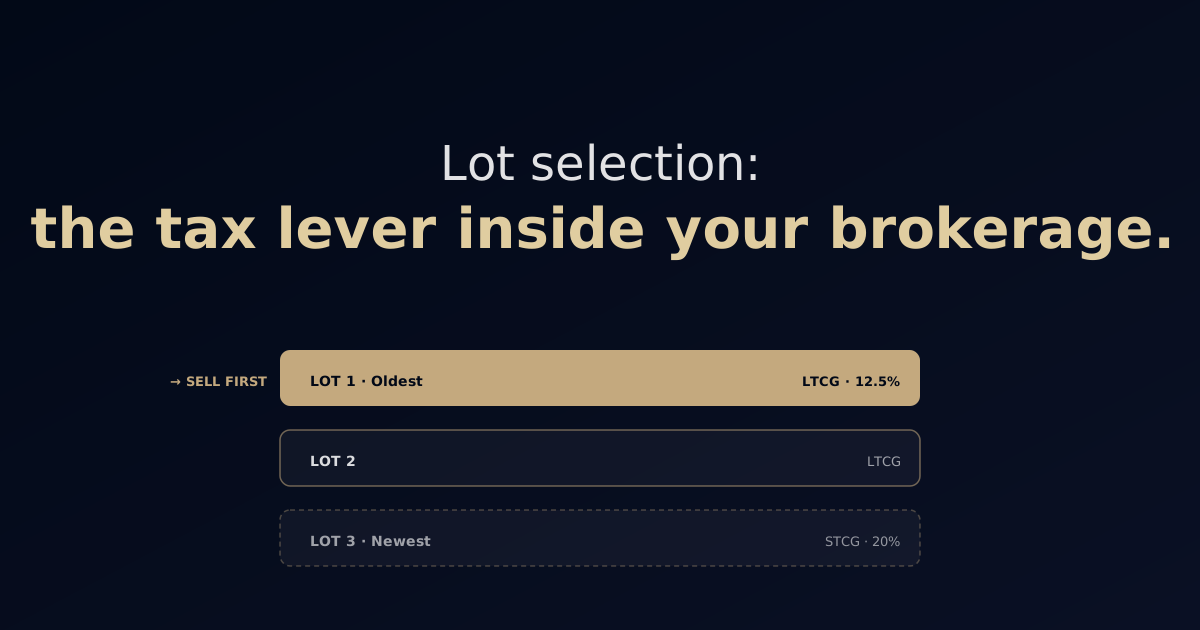
If you place a sell order without specifying which lot, most brokerages default to FIFO — First In, First Out. The oldest shares are sold first.
This is often not the best tax outcome. FIFO might sell shares that are LTCG-eligible (older, cheaper lots) first, which is actually fine in that case — but it might also sell shares that have large gains when you have loss lots available that could be used to offset those gains.
The point is: defaulting to FIFO is not a strategy. It's an omission.
Four Situations Where Lot Selection Saves Meaningful Money
Situation 1: You want to sell now and some lots are LTCG-eligible, others are STCG. Strategy: Sell LTCG lots first. The tax rate is 12.5% instead of 20%. The saving on ₹5 lakh of gains is ₹37,500.
Situation 2: You have lots at a gain and lots at a loss (current price is below some vest-day FMVs). Strategy: Sell loss lots to realise a capital loss. Use it to offset capital gains in the same year. If there's no gain to offset, carry the loss forward for up to 8 years.
Situation 3: You want to minimize gains in a year when you're close to a surcharge threshold. Strategy: Sell loss lots (realising losses) or LTCG lots (lower rate) to keep total income below the threshold. Don't sell STCG lots this year if you're about to cross ₹50 lakh total income.
Situation 4: You have lots with very similar cost basis and current price (minimal gain or loss). Strategy: Sell these lots first to minimise tax, while holding higher-gain lots for longer (toward LTCG threshold).
How to Specify a Lot in Schwab
1. Log in to Schwab Equity Award Center or your linked brokerage account. 2. Go to Accounts → Positions → [Your company stock]. 3. Click Sell or Trade. 4. In the sell order form, look for "Cost Basis Method" or "Tax Lot Selection." 5. Choose "Specific ID" or "Specific Shares" — this allows you to select which exact lot you're selling. 6. Select the lot(s) you want, confirm the number of shares. 7. Place the order.
The exact interface varies by brokerage, but most major platforms (Schwab, Fidelity, E*TRADE) support lot-specific selling. If you don't see the option, contact your brokerage's customer support.
📊 TABLE: "Lot Selection Decision Matrix" [Insert here: 4-row table] Your situation | Recommended lots to sell first | Reason LTCG > 24 months, any gain | Oldest lots (LTCG eligible) | Lower tax rate Some lots below vest-day FMV | Loss lots | Realise loss to offset gains Near surcharge threshold | Loss lots or smallest-gain lots | Minimise taxable income Near 24-month mark on some lots | Wait a few weeks for those | Converts STCG to LTCG
What Your Ca Needs for Lot-level Reporting
When you file your ITR, capital gains must be reported at the lot level — specifically, in Schedule CG you'll need for each sale:
- Date of acquisition (vest date) - Cost of acquisition (FMV on vest date in INR) - Date of sale - Sale price (in INR at TTBR) - Nature of capital gain: LTCG or STCG
Your brokerage gain/loss report will have all of this if you've sold shares during the year. Download the detailed version — not just the summary — and share it with your CA.
How Rovia Can Help
Rovia will map your full lot picture — sorted by LTCG status, gain/loss position, and holding period. We'll tell you exactly which lots to sell in what sequence to achieve the most tax-efficient outcome given your specific situation.
This is not generic advice. It depends on your lots, your income, your other capital gains and losses, and your plans for the stock. We'll do the analysis for your specific numbers.