Every April, a certain number of Indian tech employees get a rude surprise when filing their ITR: an interest charge of ₹20,000, ₹50,000, or more — not because they didn't pay their taxes, but because they didn't pay them on time.
This is the advance tax penalty. It's entirely avoidable. And RSU holders are particularly prone to it, because the income profile — multiple perquisite events plus capital gains from sales — is harder to estimate than a simple salary.
What Advance Tax is and Who Must Pay it
Advance tax is income tax paid in installments during the financial year, as income is earned, rather than all at once at the end.
If your total tax liability (after TDS already deducted) exceeds ₹10,000 in a financial year, you must pay advance tax. For most senior tech employees with RSUs, this threshold is crossed easily.
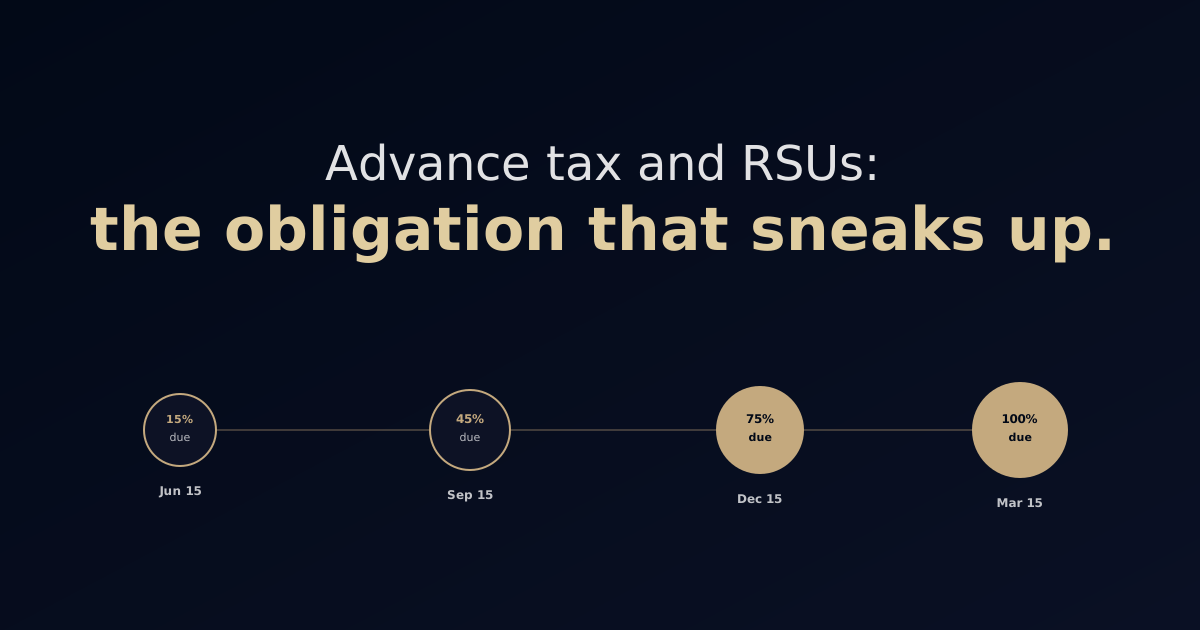
The installment schedule for FY 2025–26: - By June 15: 15% of estimated annual tax - By September 15: 45% of estimated annual tax - By December 15: 75% of estimated annual tax - By March 15: 100% of estimated annual tax
How Rsus Create an Advance Tax Obligation
Your employer deducts TDS on your RSU perquisite income through sell-to-cover — so that part is handled.
The advance tax gap arises from two sources:
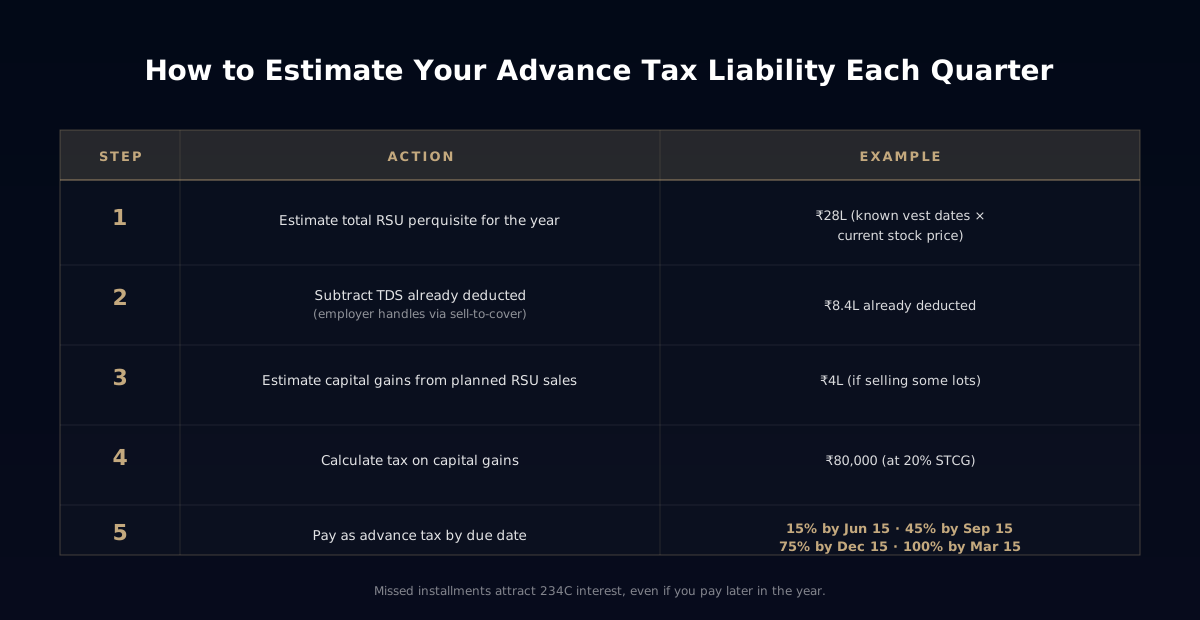
1. Capital gains from RSU shares you sell yourself: These are not covered by any TDS. If you sell ₹15 lakh worth of RSU shares and generate ₹3 lakh in capital gains, you owe capital gains tax (₹45,000–₹60,000 depending on STCG/LTCG). This must be paid via advance tax, not held back to filing time.
2. Shortfall if TDS on perquisite is insufficient: If your effective tax rate is higher than what the sell-to-cover covered (because of surcharge, or because your total income pushed you into a higher bracket), the difference is your advance tax obligation.
The Interest Penalty for Missing Installments
Section 234B: Interest at 1% per month (simple interest) on the total advance tax shortfall from April 1 of the assessment year until filing. A ₹1 lakh shortfall carried from April to July = ₹3,000 in interest (3 months). Not catastrophic, but avoidable.
Section 234C: Interest at 1% per month for each installment that was short of its required percentage. Calculated separately for each of the four installment dates.
A common scenario: you sell RSU shares in June, generating ₹5 lakh in capital gains. You don't adjust your September advance tax installment to include this. At filing, you pay the tax but face 234C interest for the September and December shortfalls. The interest might be ₹8,000–₹15,000 — small in absolute terms, but entirely avoidable.
The Special Rule for Capital Gains
There's a technical provision that helps: advance tax on capital gains need only be paid in the installment after the gain is actually realised.
So if you sell shares in October and generate capital gains, you can include that in the December 15 installment — you don't need to have anticipated it in June or September.
But: if you sold shares earlier in the year and didn't adjust, the missed installments attract 234C interest.
The practical advice: if you made any significant RSU sales in a quarter, add the capital gains tax estimate to your advance tax payment for the following installment.
How to Pay Advance Tax
Advance tax is paid via Challan 280 on the Income Tax Department's online portal (incometax.gov.in) or through your bank's net banking. Select "Advance Tax (100)" as the payment type.
Keep the challan receipt. It confirms payment and will be reflected in your Form 26AS and AIS.
Source: Challan 280 advance tax payment: https://incometax.gov.in/iec/foportal/help/individual/advance-tax
How Rovia Can Help
Advance tax planning is something most people do reactively — after the interest has already been charged. Rovia helps you set it up proactively: we'll look at your vest schedule, your likely capital gains from planned sales, and help you calculate the advance tax installments you should be making.
Once you have the numbers, we'll remind you when each installment is due.
Source: Section 234B and 234C, Income Tax Act: https://incometaxindia.gov.in