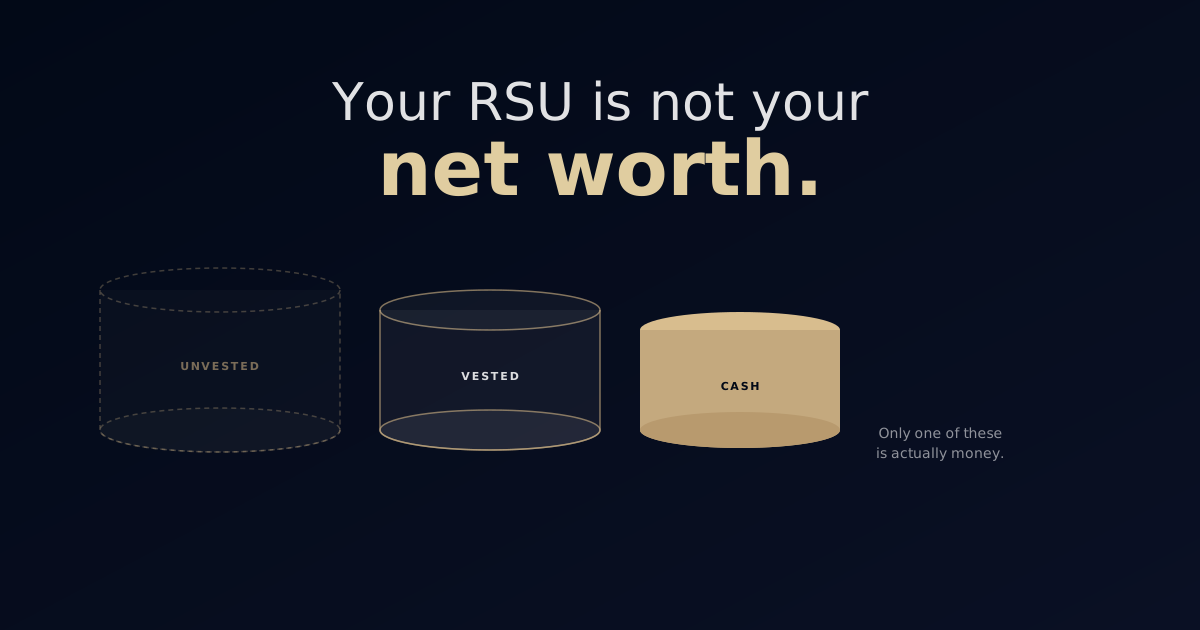
This might be the most important clarification in this entire series.
In conversations about personal finance, in Slack channels, in family WhatsApps, in the engineer's mind running mental calculations about whether they can afford a flat — RSU wealth often gets counted as if it's money in the bank.
It isn't. And the difference matters more than most people want to acknowledge.
Three Buckets, Very Different Things
Your equity situation at any point in time actually contains three distinct categories. Each behaves differently and deserves to be treated differently.
Bucket 1: Unvested RSUs These are promises. You don't own them. You cannot sell them, borrow against them, or count them as assets in any legally binding financial context. They could be forfeited (if you leave), they could be worth much less (if the stock falls), or they might not materialise at all (performance conditions, company events).
Their correct financial treatment: future income that you're working toward, not present wealth.
Bucket 2: Vested but unsold shares These are real assets. You own them. They have market value. But they're not cash.
To turn them into cash, you have to: make a sell decision, execute a brokerage transaction, wait for settlement (T+2), pay capital gains tax (reducing what you receive), and then actually transfer the money. That process takes days and has costs.
Additionally, the value fluctuates daily. The ₹50 lakh you think you have in vested shares could be ₹43 lakh in a week if the stock moves.
Bucket 3: Liquid cash from RSU proceeds This is the money that's actually in your bank account — post-sale, post-tax, post-currency conversion. This is real, spendable, loan-collaterisable wealth.
📊 INFOGRAPHIC: "The Three Buckets of RSU Wealth" [Insert here: Three bucket visual] Bucket 1: Unvested RSUs → Conditional. Can be forfeited. Cannot sell. → Treat as: Future income being earned, not present wealth.
Bucket 2: Vested, unsold shares → Real asset, but not cash. Subject to price risk. → Treat as: Investment position requiring active management.
Bucket 3: Liquid cash (post-sale, post-tax) → Actual money. → Treat as: Part of net worth.
Where People Get Into Trouble
The trouble usually comes from conflating buckets and making decisions that require the liquidity of Bucket 3 based on the value of Bucket 1 or 2.
Home loans: Lenders will sometimes factor in RSU income (Bucket 2 projected into the future) when assessing loan eligibility. But that income is neither guaranteed nor liquid. An EMI you can service now from salary becomes an EMI you're struggling with if the company's stock falls 30% and you don't want to sell at a bad time.
Investment decisions: "I'll invest the RSU money in mutual funds" — before it has actually vested and been sold. Circular financial planning.
Early retirement or sabbaticals: Calculating financial independence based on unvested RSU value. If 60% of your assumed wealth hasn't vested yet, your independence date isn't what you think it is.
How to Do an Honest Financial Snapshot
Once a year, do this exercise:
1. List all vested shares: current market value. This is your equity position. 2. Subtract the capital gains tax you'd owe if you sold today. This is your post-tax equity value. 3. Add your actual cash savings and other liquid investments. 4. List unvested RSUs separately, with a discount for uncertainty (many advisors use 50–70% of face value to account for stock price risk). 5. Do not combine 3 and 4 into a single "net worth" number. They represent different things.
This honest snapshot often reveals that people are significantly less wealthy than they thought — because they were counting unvested RSUs at face value as if they were cash.
How Rovia Can Help
A big part of what Rovia does is help you get clear on exactly what you have: what's vested, what the post-tax value is, what's unvested and at what probability-weighted value. That clarity is the foundation of every other financial decision — home purchase, investment allocation, retirement planning.
You can't plan from a number that isn't real. We'll help you find the real one.


