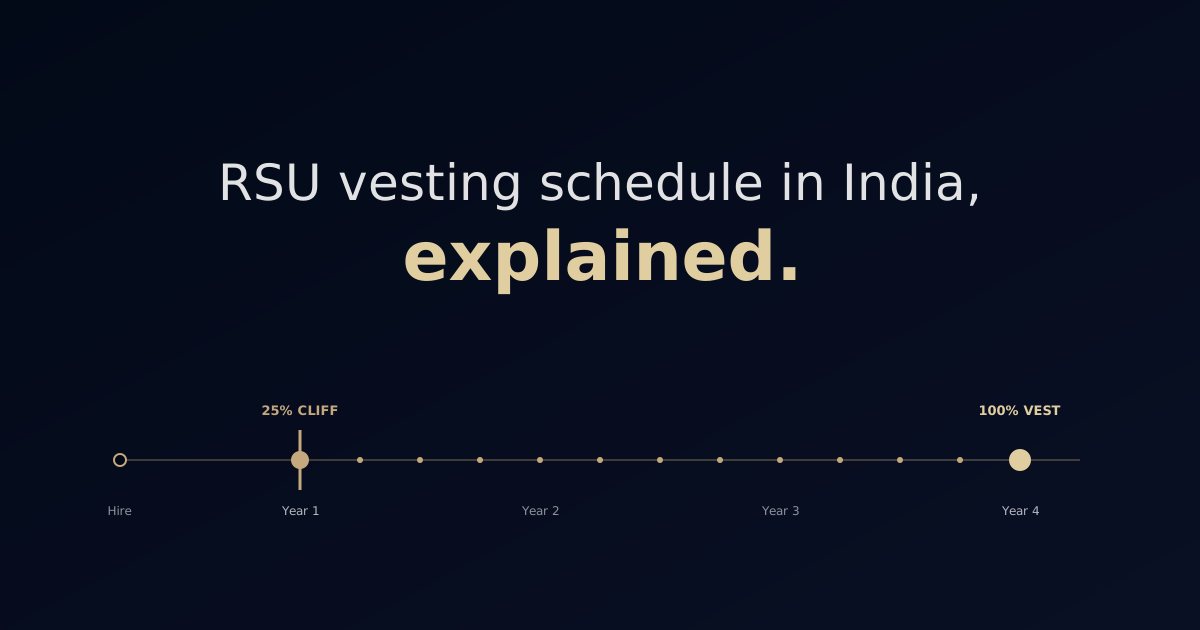
You probably have your vesting schedule memorised. Four years. One-year cliff. Quarterly after that. Or maybe monthly.
What most people don't know is what the structure actually means for their money, their tax filing, and their financial decisions. A vesting schedule is not just a timeline — it is a financial event calendar that affects everything from how much advance tax you owe to whether leaving in March costs you more than leaving in April.
This guide covers how standard schedules work, how monthly and quarterly vesting differ in practice, how Amazon does it differently, and what refresher grants do to your long-term RSU exposure — with India-specific tax implications throughout.
How the standard four-year vesting schedule works
Most large US tech companies — Google, Amazon, Microsoft, Meta, Salesforce, Qualcomm — use a four-year vesting schedule. The structure is almost always the same:
Year 1: 25% vests all at once on your one-year work anniversary. This is called the cliff.
Years 2 to 4: The remaining 75% vests in equal instalments, either monthly or quarterly depending on the company.
The cliff is the most financially significant feature of the entire schedule. Leave before your one-year anniversary and you walk away with nothing from that grant. Zero. The day after the anniversary, 25% is yours. The day before, none of it is.
That gap is often worth lakhs — for senior employees, crores. It is one of the most concrete financial incentives to stay through that first year, and it is why leaving at month eleven is a categorically different decision from leaving at month thirteen.
| Month | Shares vested (% of grant) | Cumulative total | What happens |
|---|---|---|---|
| Month 0–11 | 0% | 0% | Cliff period. Nothing vests. No tax event. |
| Month 12 | 25% | 25% | Cliff vests. Perquisite income triggered. TDS deducted via sell-to-cover. |
| Month 13–24 | ~2.08% per month | 25–50% | Monthly vesting begins. Each vest = one taxable event. |
| Month 25–36 | ~2.08% per month | 50–75% | Vesting continues. Multiple cost basis lots accumulating. |
| Month 37–48 | ~2.08% per month | 75–100% | Final year. Some shares from month 12 may now qualify for LTCG. |
| Month 48 | Last tranche vests | 100% | Fully vested. Original grant complete. |
Note: Monthly cadence shown. Quarterly vesting follows the same structure but in four annual tranches of ~6.25% each after the cliff.
Monthly vs quarterly vesting — the difference is bigger than it sounds
This is one of the most overlooked distinctions in RSU planning for Indian employees.
Quarterly vesting — four taxable events per year
If your company vests quarterly, you have four perquisite events per year. Four taxable moments. Four sell-to-cover transactions. Four FMV calculations at four different stock prices. Your CA reconciles four entries against your Form 16 at filing time.
Monthly vesting — twelve taxable events per year
If your company vests monthly — Google does this — you have twelve perquisite events per year. Twelve separate brokerage entries. Twelve different FMV calculations. Twelve sell-to-cover transactions.
Each of those twelve lots also has its own 24-month LTCG clock running from its specific vest date. When you decide which shares to sell, you are choosing between lots with different cost bases, different FMV levels, and different holding period statuses. Selling the wrong lot can cost you the LTCG rate on a gain that would have qualified in a few weeks.
Key Insight
If you have been treating monthly vesting as something that "just happens automatically," you may be handing your CA an incomplete picture at filing time — and leaving the LTCG decision entirely to chance.
The back-weighted exception — how Amazon's schedule works
Amazon uses a fundamentally different structure. Instead of a straight four-year split, Amazon's schedule is deliberately back-weighted:
| Year | Percentage vesting | On a ₹1 crore grant | Notes |
|---|---|---|---|
| Year 1 | 5% | ₹5 lakh | Far less than most companies. Cliff still applies. |
| Year 2 | 15% | ₹15 lakh | Still below a standard schedule at this point. |
| Year 3 | 40% | ₹40 lakh | The bulk arrives here. Advance tax planning essential. |
| Year 4 | 40% | ₹40 lakh | Final year matches year 3. Total = 100%. |
Stock price changes will affect actual value. Figures shown assume flat stock price for illustration.
Years one and two feel lean. Year three is when the real income arrives — and for Indian employees, that means a substantial perquisite income event that needs advance tax planning well before March 31 of that financial year. Many Amazon employees get a serious surprise at tax time in year three because they did not account for it in their advance tax instalments.
If you are at Amazon
If you are in years one or two, your year-three tax bill deserves attention now. The perquisite income in year three can be 8x what you received in year one.
Refresher grants — why your RSU exposure keeps growing
Here is the part that catches most people off guard, usually around year three.
After your initial new-hire grant starts vesting, most large tech companies issue additional RSU grants as part of annual performance reviews. These are called refresher grants. Each refresher has its own four-year vesting schedule starting from when it was issued.
So by year three at a company, you might be vesting simultaneously from three separate grants at once:
Your original new-hire grant (in its final two years)
A year-two refresher (in its first two years)
A year-three refresher (just started)
| Year | Original grant (A) | Year 2 refresher (B) | Year 3 refresher (C) | Total vesting |
|---|---|---|---|---|
| Year 1 | 25% of A | — | — | A × 0.25 |
| Year 2 | 25% of A | 25% of B | — | (A × 0.25) + (B × 0.25) |
| Year 3 | 25% of A | 25% of B | 25% of C | (A × 0.25) + (B × 0.25) + (C × 0.25) |
| Year 4 | 25% of A | 25% of B | 25% of C | (A × 0.25) + (B × 0.25) + (C × 0.25) |
| Year 5 | — | 25% of B | 25% of C | (B × 0.25) + (C × 0.25) |
The practical consequence: your quarterly RSU income is a combination of all active grants, and your single-stock concentration keeps rebuilding even as the original grant runs out. The more senior you are, the bigger the refreshers, and the faster the concentration grows. Long-tenured tech employees frequently hold far more concentrated RSU positions than they realise — not because they made a conscious decision to hold, but because each new refresher quietly replenished what the previous grant was depleting.
Worked example — what a vesting schedule actually means in rupees
Priya is a senior engineer at Google. She received a new-hire grant of 100 RSUs in April 2023. Google vests monthly.
In April 2024 — her one-year cliff — 25 shares vest. Google's stock is at $175 that day. The rupee equivalent at ₹83 to the dollar is ₹14,525 per share.
| Item | Calculation | Amount |
|---|---|---|
| Perquisite income at cliff | 25 shares × ₹14,525 | ₹3,63,125 |
| TDS at 30% slab | 30% of ₹3,63,125 | ₹1,08,937 |
| Shares sold to cover (approx.) | TDS ÷ FMV per share | 7–8 shares |
| Shares received in account | 25 minus shares sold | ~17–18 shares |
| Cost basis per share | FMV on vest date | ₹14,525 |
| LTCG threshold date | 24 months from vest | April 2026 |
From May 2024 onwards, approximately 2.08 shares vest each month. Each monthly tranche has its own FMV, its own cost basis, and its own 24-month LTCG clock. By April 2026, her brokerage account has 24 separate share lots, each with a different purchase price and a different holding period status.
This is why knowing your vesting schedule in detail — not just the headline numbers — matters when making any decision about selling.
Three questions to ask at every vest date
Put every vest date in your calendar and treat each one as a financial event, not just a notification.
1. How much is vesting, and what is the approximate TDS that will be deducted via sell-to-cover?
2. Of the shares I will receive, what is my plan — hold, sell, or a split? And if I am selling other shares, which lot makes the most sense from a LTCG vs STCG perspective?
3. Does this vest push my total RSU position to a concentration level I am comfortable holding?
Answering these three questions at every vest, consistently, is more useful than any complex financial model.
Frequently asked questions
What is a vesting cliff and what happens if I leave before it?
A cliff is the minimum period you must stay before any shares vest. For most tech companies this is one year. Leave before your one-year anniversary and you forfeit the entire grant — none of it vests. The day after the cliff, 25% of your grant becomes yours. This is why leaving in month eleven is fundamentally different from leaving in month thirteen.
Does it matter whether my company vests monthly or quarterly for tax purposes?
Yes, significantly. Each vest is a separate taxable event in India. Monthly vesting creates twelve perquisite income entries per year — each with its own FMV, cost basis, and 24-month LTCG clock. Quarterly vesting creates four. Monthly vesting requires more careful lot tracking when you decide to sell, because different lots from different months will reach the LTCG threshold at different times.
Why does Amazon's vesting schedule feel so different in the first two years?
Because it is. Amazon deliberately back-loads its schedule — 5% in year one, 15% in year two, 40% in year three, 40% in year four. This is structurally designed to incentivise employees to stay through years three and four. The financial planning implication for Indian employees is that advance tax obligations in year three can be significantly larger than expected if not planned for.
What is a refresher grant and when do companies issue them?
A refresher is an additional RSU grant issued by the company, typically during the annual performance review cycle. Each refresher has its own four-year vesting schedule. By year three at a company, most employees are vesting from two or three grants simultaneously — their original grant and one or two refreshers. This is what causes RSU concentration to keep growing even as the original grant winds down.
How does the 24-month LTCG threshold work when I have multiple vesting lots?
Each lot of shares is counted separately from its own vest date. Shares that vested in January 2025 reach the 24-month LTCG threshold in January 2027. Shares that vested in June 2025 reach it in June 2027. When deciding which shares to sell, always check the vest date of each lot — selling a lot that is one month away from LTCG qualification at the STCG rate is an avoidable tax cost.
Do I need to track each monthly vest separately for my ITR filing?
Yes. Each vest is a separate perquisite income event under Section 17(2)(vi). Your Form 16 should reflect all of them, but you need to verify this against your brokerage statement. When you sell shares, the capital gain calculation for each lot uses the FMV from that specific lot's vest date as the cost of acquisition — not an average. Your CA needs the complete vest history, not just the totals.
What happens to my vesting schedule if my company is acquired?
It depends on the acquisition terms. In many cases RSUs are converted into shares of the acquiring company and continue vesting on the original schedule. In some cases they are accelerated — all unvested shares vest immediately. In others they are cancelled with a cash payment. This is covered in your equity plan documents under "change of control" provisions. If your company is in an acquisition process, checking those terms should be a priority.
Sources
Amazon vesting schedule structure confirmed via levels.fyi and company public disclosures. Income Tax Act 1961 — Section 17(2)(vi): incometaxindia.gov.in. CBDT perquisite valuation rules: incometaxindia.gov.in/rules/income-tax-rules.htm


