Most people find out they're getting RSUs the way they find out about a lot of things at work — buried in an offer letter, explained in a 20-minute HR call, and then more or less forgotten until the shares actually show up. If that's you, you're not alone. And honestly, even people who have been vesting for years often don't fully understand what they own, when they own it, or what it costs them.
Let's fix that.
The Promise, Not the Thing Itself
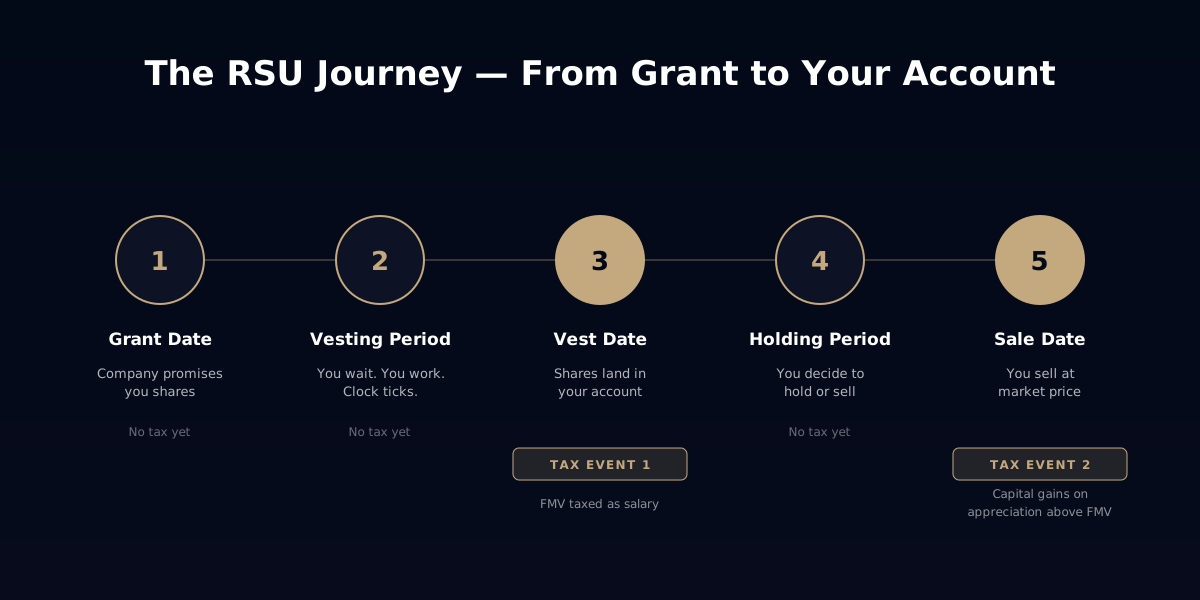
When a company grants you RSUs, they are not giving you stock. They are making a conditional promise: stay employed, meet the conditions, and we will give you actual shares at a future date.
Until that date arrives, you own nothing that has legal or financial weight. You can't sell it. You can't borrow against it. You can't include it in a loan application as an asset. It is a future right, not a present one.
The "restricted" in Restricted Stock Units refers exactly to this. The units are restricted — unavailable to you — until the restrictions are lifted. The restrictions are almost always time-based (stay for four years) and sometimes performance-based (hit certain targets). Once the conditions are met, the restriction is lifted, and the shares vest.
What Actually Happens on Vest Day
The vest date is when everything becomes real. On that day, the company instructs its brokerage platform — Schwab, Fidelity, Morgan Stanley, or whoever manages the equity plan — to deliver actual shares into your account. You become a shareholder. You have legal ownership.
Two things happen simultaneously the moment those shares land:
1. You become an owner of that stock. 2. A tax event is triggered.
The Income Tax Act in India (Section 17(2)(vi)) treats the Fair Market Value of those shares on the vest date as a perquisite — a non-cash benefit from your employer. This is added to your taxable income for that financial year and taxed at your income slab rate. This is not optional, and it doesn't depend on whether you sell. The mere act of receiving the shares creates a tax liability.
Your employer is responsible for deducting TDS on this amount. The most common way they do it is "sell to cover" — they sell a portion of your vested shares on your behalf, use the proceeds to pay the TDS, and credit the remaining shares to your account. We'll cover this in a separate post, but for now: that's why you sometimes vest 100 shares and find only 70 in your account.
The Number That Anchors Everything: Fmv on Vest Date
The Fair Market Value of your shares on the vest date is not just relevant for the first tax event. It becomes your cost of acquisition — the baseline against which all future capital gains are measured.
If you bought shares at ₹0 and sold them for ₹500, your capital gain would be ₹500. But that's not how RSUs work. Your "purchase price" for tax purposes is the FMV on vest day. So if shares vest at ₹500 and you sell at ₹600, your capital gain is only ₹100 per share — not ₹600.
This single concept eliminates the most common RSU tax misconception: "I'll owe tax on everything when I sell." You won't. The income tax at vest covers the FMV portion. Capital gains only apply to appreciation above that.
After Vest: You Are Now an Investor
This is the part most people don't sit with long enough.
From the moment those shares land in your brokerage account, you are not just an employee receiving compensation. You are an investor holding a position in a publicly traded company. The fact that you received those shares as part of your job doesn't change how the market treats them.
Every day you choose not to sell, you are implicitly choosing to hold. That is an investment decision, whether you treat it like one or not.
The most common pattern we see: shares vest, they sit in the Schwab account, more shares vest, the position grows, the concentration climbs, and the decision of what to do gets deferred indefinitely. Not because of a strategy — but because deciding feels harder than not deciding.
What About Unvested Shares?
They don't exist in any financial sense yet. You don't need to report them anywhere. You cannot include them in your net worth in any legally meaningful way. They are an expectation — contingent on you staying, the company continuing to operate, and the vesting conditions being met.
This matters enormously when you're making major financial decisions. If you're calculating how much home loan you can afford, or whether you can afford to take a sabbatical, basing that calculation on unvested RSUs is risky. They might not materialise. The stock price might be very different. The company might have a rough year.
Count only what has actually vested. Everything else is upside you're working toward.
The One Thing to Take From This
RSUs are taxed twice: first as salary when they vest, then as capital gains when you sell. The base for the second tax is the FMV on vest day — not zero, not the original grant price, and not what the stock is worth today.
That's the foundation. Everything else in RSU financial planning — tax timing, diversification, lot selection, cross-border investing — builds on this.
How Rovia Can Help
Most people figure this out in year two or three of vesting, after they've already made a few expensive decisions without understanding the full picture. Rovia exists to compress that learning curve.
Whether you've been vesting for one year or ten, we'll map out exactly what you have, what it's worth, what you've already paid in tax, and what your options are. No jargon. No pressure. Just a clear picture of your equity and a plan for what to do with it.
Source: Income Tax Act, 1961 — Section 17(2)(vi): https://incometaxindia.gov.in Source: CBDT perquisite valuation rules: https://www.incometaxindia.gov.in/rules/income-tax-rules.htm


