It happens to almost everyone the first time.
You've been waiting for this vest date. You know 100 shares are supposed to land in your Schwab account. You check, and there are 68. Or 71. Or some number that's clearly less than 100.
The first reaction is usually confusion, sometimes mild panic. Did something go wrong? Did the company make an error? Did shares go somewhere else?
Nothing went wrong. What you experienced is "sell to cover" — one of the most common mechanics in equity compensation that almost nobody explains before your first vest.
What Sell to Cover Actually is
When your RSUs vest, the Indian government immediately treats the full Fair Market Value of those shares as salary income. Your employer is required to deduct TDS on that amount under Section 192 of the Income Tax Act — just like they deduct TDS on your monthly salary.
But here's the problem: this income isn't cash. It's shares. You didn't receive money you could use to pay the tax. You received stock.
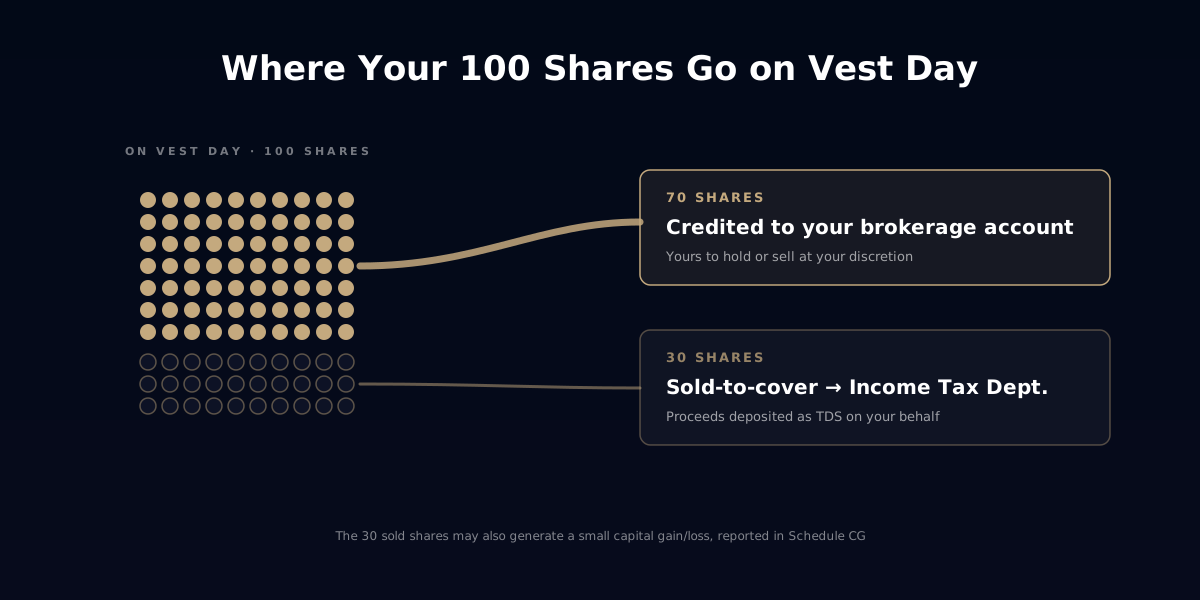
So the employer does the logical thing: they sell a portion of your newly vested shares, use the proceeds to pay your TDS, and give you the rest.
That's sell to cover. Shares sold, on your behalf, before you ever see them, to pay a tax bill you incurred by receiving the shares in the first place.
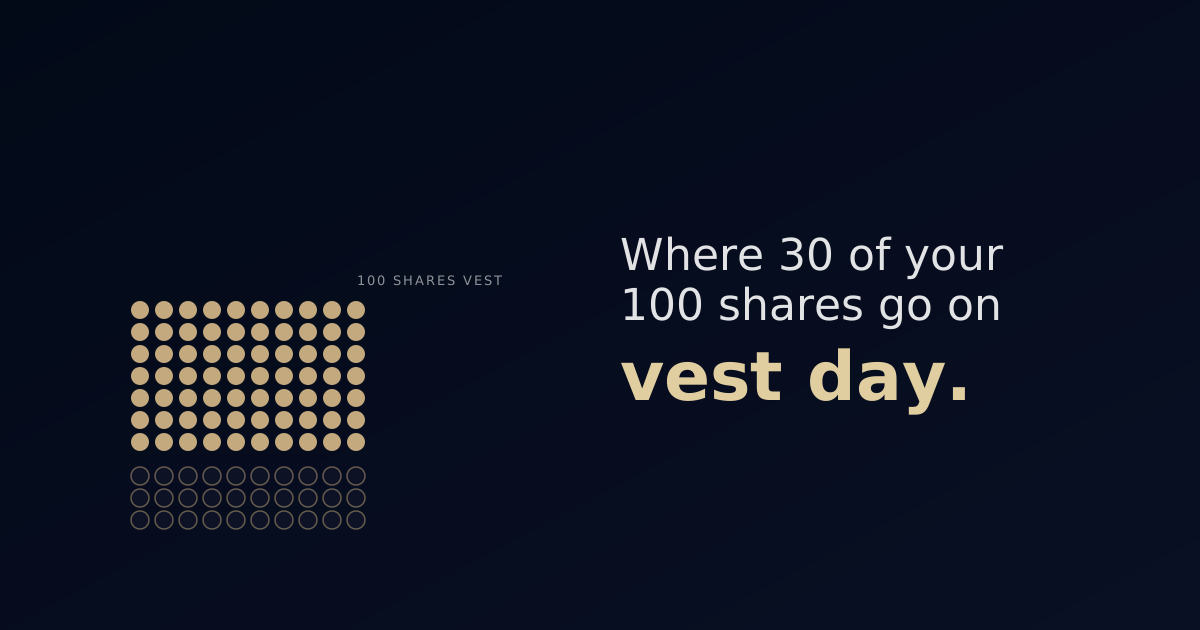
If you're in the 30% tax bracket and 100 shares vest, approximately 30 shares get sold to pay the TDS. You receive roughly 70. (The actual number varies slightly because of surcharge, cess, and the share price on the day of the sell-to-cover transaction.)
Who Decides to Sell to Cover?
It's usually the company's default setting, and in most cases it's the only option available. A few companies offer alternatives:
Same-day sale: All vested shares are sold immediately. You receive cash, not shares. The tax is paid from the proceeds, and the remainder is wired to you.
Net settlement (net share withholding): The company withholds shares to cover the tax instead of selling them. You receive fewer shares, but no shares are actually sold. This is less common and often only available to employees in specific geographies.
Upfront cash payment: You pay the TDS from your own bank account, and the full 100 shares are delivered to you. Few companies offer this, and most employees don't want to tie up that much liquidity.
For most Indian employees at US tech companies, sell to cover is the default, and it happens automatically.
The Side Effect: a Small Taxable Event From the Sell Itself
Here's something most people don't realise: the sell-to-cover transaction — those 30 shares that got sold — also technically creates a capital gains event.
The shares were delivered at an FMV of, say, $150. They were sold at, say, $150.10 (the market price at the time of sale, which is rarely identical to the vest-price FMV used for perquisite calculation). That ₹0.10 difference, multiplied by 30 shares, is technically a capital gain (or loss) that should be reported in your ITR.
In practice, this amount is usually very small — often a few hundred rupees. But it exists, your CA should account for it, and it does show up in your brokerage's gain/loss report.
How This Shows Up in Your Documents
At year-end, you'll see three things:
1. Your Form 16 from your employer will show the full perquisite value of all 100 shares in Part B. Not 70 — 100. The tax was on all 100, even though you only received 70.
2. Your brokerage statement will show the sell-to-cover transactions — small sales that happened on or around your vest dates.
3. Your Form 26AS / AIS will reflect the TDS deposited by your employer.
When your CA is filing your ITR, they need all three. The common error is giving them only the Form 16 and ignoring the brokerage statement — which means the sell-to-cover capital gains (even if tiny) go unreported, and the reconciliation breaks down.
What to Do About it
Nothing dramatic. Sell to cover is simply the mechanism. What matters is what you do with the shares you receive.
What you can control: - Understanding that the shares you receive are already "after tax" — you've already paid income tax on the full vest value. - Keeping your brokerage gain/loss report ready for your CA. - Factoring in that your effective number of vested shares is always lower than your scheduled number — so if you're modelling future wealth based on RSU grants, apply a 25–35% tax haircut.
How Rovia Can Help
If your brokerage statements look confusing, if your Form 16 and Schwab account don't seem to match, or if you're not sure whether your CA has the right picture of your equity — Rovia can help you reconcile all of it.
We work with your brokerage data and your Form 16 to make sure nothing falls through the cracks, and we help you understand what you're actually receiving after tax — not just what the grant letter says.
Source: TDS on RSU perquisite — Section 192, Income Tax Act, 1961: https://incometaxindia.gov.in


