Most RSU conversations assume you can sell your shares whenever you want after they vest. For employees at recently public companies, this assumption can be wrong — sometimes expensively wrong.
The lockup period is the reason. And while it's most visible around IPOs, variations of it exist in other contexts too.
What a Lockup Period is
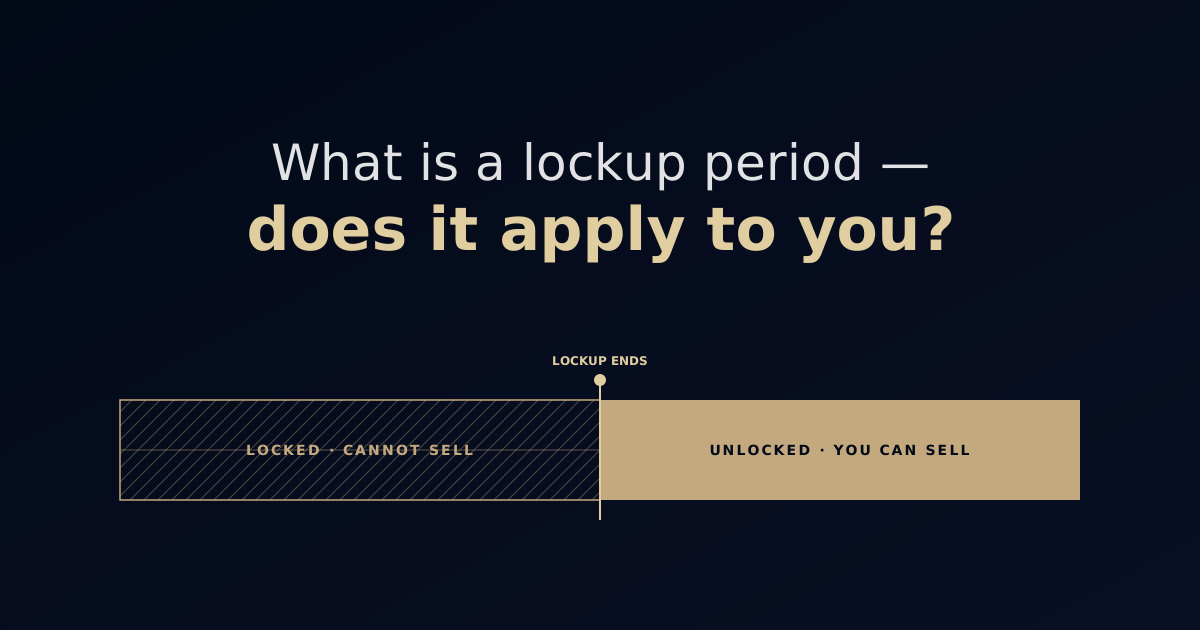
A lockup period is a contractual restriction that prevents certain shareholders — typically company insiders, employees, and early investors — from selling their shares for a defined period after a company goes public.
The standard IPO lockup is 180 days (six months) after the listing date. During this period, you cannot sell your shares in the open market, even if they've already vested.
The lockup exists to prevent a flood of insider selling immediately after IPO, which would drive the stock price down and undermine market confidence in the new listing.
Who it Applies to
IPO lockups typically apply to: - Current employees who hold vested shares at the time of IPO - Pre-IPO investors and venture funds - Company executives and directors
Post-IPO hires at the same company generally don't have lockup restrictions — their RSUs vest under the normal post-IPO vesting schedule with no lockup.
For employees at companies that listed recently — Freshworks (NASDAQ, 2021), Swiggy (NSE/BSE, 2024) — understanding whether and when the lockup ended is directly relevant to what you can do with your equity.
The Tax Event Still Happens
This is the critical point most people miss.
Even during lockup, if your RSUs vest, the tax event occurs. The FMV on the vest date is added to your salary. TDS is deducted (through sell-to-cover or cash, depending on the company's policy).
But the sell-to-cover creates a problem: if shares can't be sold in the open market during lockup, the company may handle this differently — either requiring you to pay TDS in cash, or making specific arrangements for the tax sale. Check your company's equity plan document for how they handle vest-day TDS during lockup.
The worst situation: RSUs vest at a high price during lockup, you pay tax on that high price, the stock then falls before lockup ends, and you sell at a lower price — creating a capital loss on top of the income tax you've already paid.
📊 TABLE: "Lockup Scenario — What It Can Mean" [Insert here: Table] Event | Date | Stock price | Tax consequence RSUs vest (100 shares) | March 1 (during lockup) | $50/share | Perquisite tax on $5,000 (≈ ₹4.2L). Cannot sell. Lockup ends | April 15 | $38/share | You can now sell, but price is 24% lower than vest day Sells all shares | April 20 | $38/share | Capital loss of $12/share — can carry forward
Secondary Sales and Tender Offers: Liquidity Before Lockup
Some employees at pre-IPO companies get liquidity before the IPO through secondary sales or company-sponsored tender offers.
Secondary sale: A third-party buyer purchases your vested shares directly from you. Requires company approval in most cases. The price is negotiated, not market-determined.
Tender offer: The company (or its investors) offers to buy back vested shares at a specific price, in a structured process. Employees can choose to participate or not.
Both options have their own tax implications — the sale price relative to the FMV at vest determines capital gains, and these need to be reported in Schedule CG of your ITR.
Post-lockup Planning
Once lockup ends, you're in the same position as any other RSU holder: you have shares, you have decisions to make.
Two things are different post-lockup: - The shares have been outstanding for some time, potentially with significant price movement. - Other insiders and investors are also now free to sell, which can create selling pressure.
There's no universal rule here. But the post-lockup window is a moment where having a plan in place — rather than deciding in the middle of market volatility — is particularly valuable.
How Rovia Can Help
If you're approaching a lockup expiry, have shares from a pre-IPO company, or are trying to understand what you can and can't do with your equity right now — Rovia can help you map the timeline, understand the tax, and make a decision that's informed rather than rushed.
Source: Freshworks IPO lockup details — NASDAQ listing, September 2021: https://www.sec.gov/cgi-bin/browse-edgar?action=getcompany&CIK=FRSH Source: Swiggy IPO — NSE/BSE listing, November 2024: https://www.nseindia.com


