The most expensive day in many tech employees' careers isn't their first day. It's the day they resign — and the cliff date they didn't quite make.
Leaving a job is complicated enough emotionally. Understanding what happens to your equity when you do is a practical question with a potentially six-figure answer.
UNVESTED RSUs: ALMOST ALWAYS FORFEITED
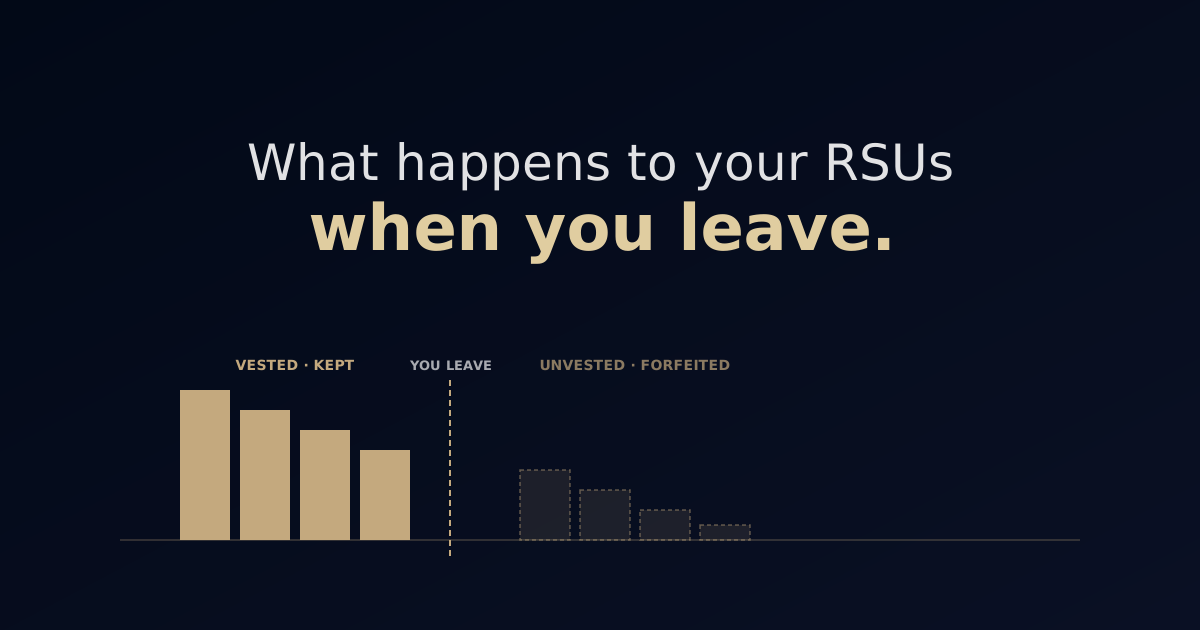
When you leave a company, unvested RSUs are typically forfeited. They go back to the company. You receive nothing for them.
This applies whether you resign, are laid off, or are let go for performance. The one exception is termination-related acceleration: some employment agreements (more common for executives than individual contributors) include a provision that a certain number of unvested grants vest immediately upon termination without cause. Check your grant agreement specifically — this is not a default provision.
For most employees, the unvested RSUs simply disappear on your last day.
VESTED RSUs: ENTIRELY YOURS
Any RSU that has already vested belongs to you. Leaving the company has no effect on shares you've already received. They sit in your brokerage account, you can sell them or hold them, and the company has no claim on them.
The only thing that changes post-exit is that your employer is no longer automatically handling TDS through sell-to-cover. When you sell those shares as a former employee, you pay the capital gains yourself — either through advance tax or at filing time. This is one of the tax adjustments people forget to make in the year they leave.
The Cliff Date Calculation
If you're anywhere in your first year at a company and you're considering leaving, you need to do this calculation before you hand in your notice.
How many unvested shares do you have in the grant period that hasn't crossed the cliff? What is today's stock price? Multiply. That's the money you're leaving on the table by leaving before the cliff.
This number is often large enough to change the decision — or at least the timing of it.
📊 TABLE: "The Cost of Leaving Before vs After the Cliff" [Insert here: Example table] Scenario | Grant | Cliff date | Leave date | Shares forfeited | Cost (at ₹7,000/share) Before cliff | 400 shares | Dec 15, 2025 | Nov 30, 2025 | 400 shares | ₹28,00,000 After cliff | 400 shares | Dec 15, 2025 | Jan 15, 2026 | 300 shares (unvested) | ₹21,00,000 Difference | — | — | 46 days | 100 fewer shares forfeited | ₹7,00,000 difference
46 days of staying means ₹7 lakh less forfeited. The specific numbers will differ, but the structure of the calculation is always worth doing.
Accelerated Vesting in Acquisitions
If your company gets acquired, what happens to your unvested RSUs depends entirely on the acquisition agreement. Three common scenarios:
1. Single trigger acceleration: All unvested RSUs vest immediately when the acquisition closes, regardless of whether you're retained.
2. Double trigger acceleration: Unvested RSUs vest only if you're let go after the acquisition closes. If you're retained, you continue on the acquirer's vesting schedule.
3. Substitution: Your unvested RSUs are converted to unvested RSUs in the acquiring company, at an equivalent value, with the same vesting schedule continuing.
The specific outcome depends on the deal terms, and individual employees rarely have leverage to change them. But knowing which scenario applies helps you understand your financial position during an acquisition.
Post-exit: the Brokerage Account Continues
Your Charles Schwab or Fidelity account doesn't close when you leave. The shares you own are yours. The account stays active.
What does change: - New grants stop. - The sell-to-cover mechanism ends (you're responsible for your own tax payments on future sales). - You may lose access to insider trading windows and blackout periods (which now apply only to current employees).
Some companies have specific post-employment sale windows. Check your insider trading policy — as an ex-employee, you may need to follow certain procedures for the first few months.
The 30-day Checklist When You Leave
In the month after you leave, do these things:
1. Note your last vesting date and confirm which shares actually vested before your exit. 2. Download a complete brokerage statement through your last day — this will be needed for your ITR. 3. Check whether your company has any post-employment selling restrictions. 4. Inform your new employer's HR that you hold foreign shares (for Schedule FA disclosure purposes — your residential status doesn't change). 5. Shift to self-managed advance tax for the year you leave, since TDS on future RSU gains won't happen automatically.
How Rovia Can Help
If you're leaving a company and trying to figure out what you have, what you're giving up, what you owe in taxes on the shares you're keeping, and how to move forward — Rovia can walk through all of it with you.
A lot of the financial planning around leaving a company centres on the equity. We'll help you make a clear-eyed decision, not one driven by anxiety or incomplete information.


