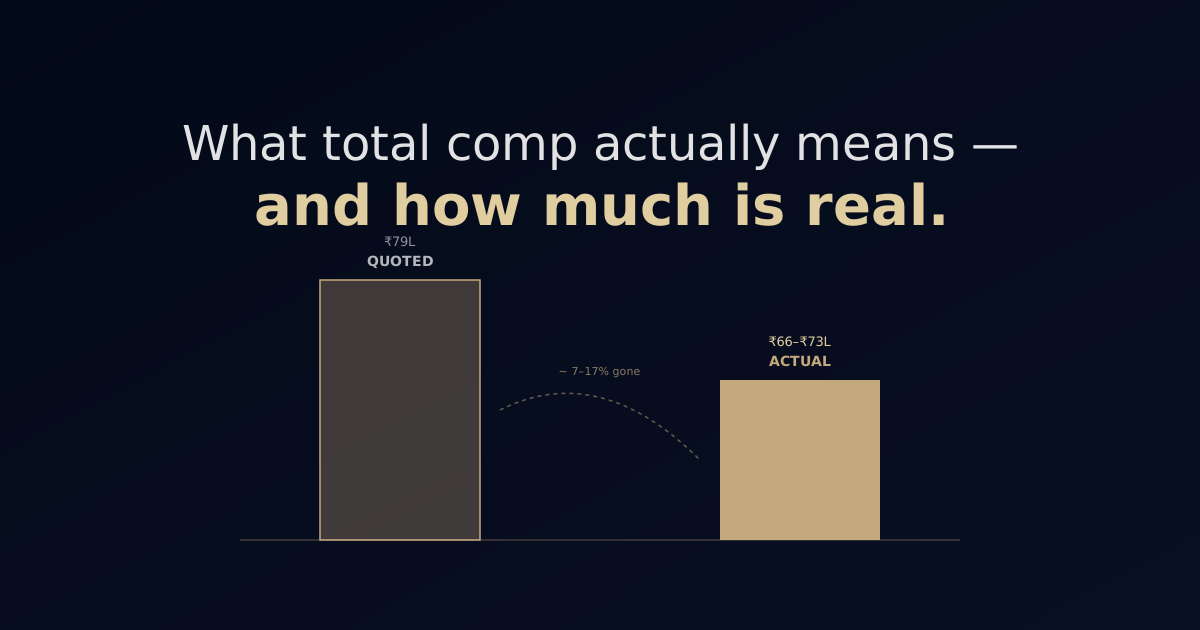
At some point in a job negotiation, a recruiter will hand you a number and call it "total comp." The number will be large. It will feel real. And a meaningful part of it — sometimes more than half — will be RSUs quoted at today's stock price, over a four-year vesting period, under the assumption that everything goes according to plan.
Here's how to read it honestly.
How Total Comp is Calculated (and Where it Misleads)
A typical offer might look like this:
Base salary: ₹40,00,000/year Annual bonus target: ₹8,00,000/year RSU grant: $150,000 over 4 years → $37,500/year → ₹31,25,000/year at current exchange rate
Total comp: ₹79,25,000/year
This math is technically accurate and practically misleading. Here's why.
The RSU figure is calculated using today's stock price. In four years, the price will be different — possibly higher, possibly lower, possibly much lower. You're being quoted a number that's part salary (certain) and part investment return (not certain).
The RSU figure ignores tax. You don't receive $150,000 worth of shares and keep all of it. At vest, roughly 30–35% goes to TDS. Your after-tax RSU income is significantly lower.
The RSU figure assumes you stay. If you leave before the cliff, the year-one RSU value is zero. If you leave at year three, you only realised half of the grant. The total comp figure assumes full completion.
The RSU figure ignores currency risk. If the rupee strengthens against the dollar during your vesting period, the INR value of your shares decreases even if the stock price stays flat.
📊 TABLE: "Total Comp vs What You Actually Receive — A Worked Example" [Insert here: Comparison table] Component | Quoted in offer | What you actually receive (estimated) Base salary | ₹40,00,000 | ₹40,00,000 (certain) Annual bonus | ₹8,00,000 | ₹6,00,000–₹8,00,000 (depends on performance) RSU (year 1) | ₹31,25,000 | ₹20,00,000–₹25,000 after TDS (depends on stock price and tax slab) Total | ₹79,25,000 | ₹66,00,000–₹73,00,000 (estimate) Note: RSU figures are illustrative. Actual values depend on stock price, currency, and slab rate.
The Four Uncertainties in Your Rsu Comp
Before you take any RSU-quoted total comp at face value, run it through these four filters:
1. Stock price risk: Where will the stock be when each tranche vests? For a four-year grant, you're making assumptions about 16 quarterly prices. No one knows them.
2. Tax haircut: Apply 30–35% to the RSU portion as a rough tax cost. The after-tax value is what you'll actually take home.
3. Vesting completion: Will you stay for the full four years? If there's a reasonable chance you won't — or if the role feels uncertain — the expected value of the RSU is lower than the face value.
4. Refresher uncertainty: Companies typically issue refreshers, but they're not guaranteed. The total comp number usually only accounts for the initial grant.
How to Compare Offers That Have Different Mixes
This is where it gets genuinely useful. If you're comparing two offers with different salary/RSU balances, here's a cleaner way to think about it:
Discount the RSU by 35% for tax. Discount the RSU by another 10–20% for stock price uncertainty (unless you have a strong view on the stock). For unvested RSUs at your current company, calculate what you're leaving on the table before making the switch.
A slightly lower total comp number with more of it in salary and less in RSUs is often worth more in practice than a higher number that's heavily equity-weighted.
The Liquidity Difference
This is underrated: salary is money you can spend. RSUs are shares you have to sell.
That means to turn RSU income into cash, you have to make an active decision, a brokerage transaction, and pay capital gains tax. This adds friction and delay. For people who need regular cash flow — for EMIs, family obligations, or investments — salary income is structurally more useful than RSU income of nominally equal value.
How Rovia Can Help
When you're evaluating an offer, we can help you model out what the RSU portion actually means in after-tax, post-currency-risk terms, and compare it clearly against your current equity position.
We've seen a lot of offers. We can tell you whether the total comp number is realistic or optimistic, and help you negotiate on the right variables.


