Most RSU discussions assume time-based vesting — stay for four years, receive shares. But not all RSU grants work this way. Some have performance conditions attached, and for employees at certain companies or levels, understanding the difference is important before you build any financial expectations around equity you haven't received yet.
Time-based Vesting: the Standard
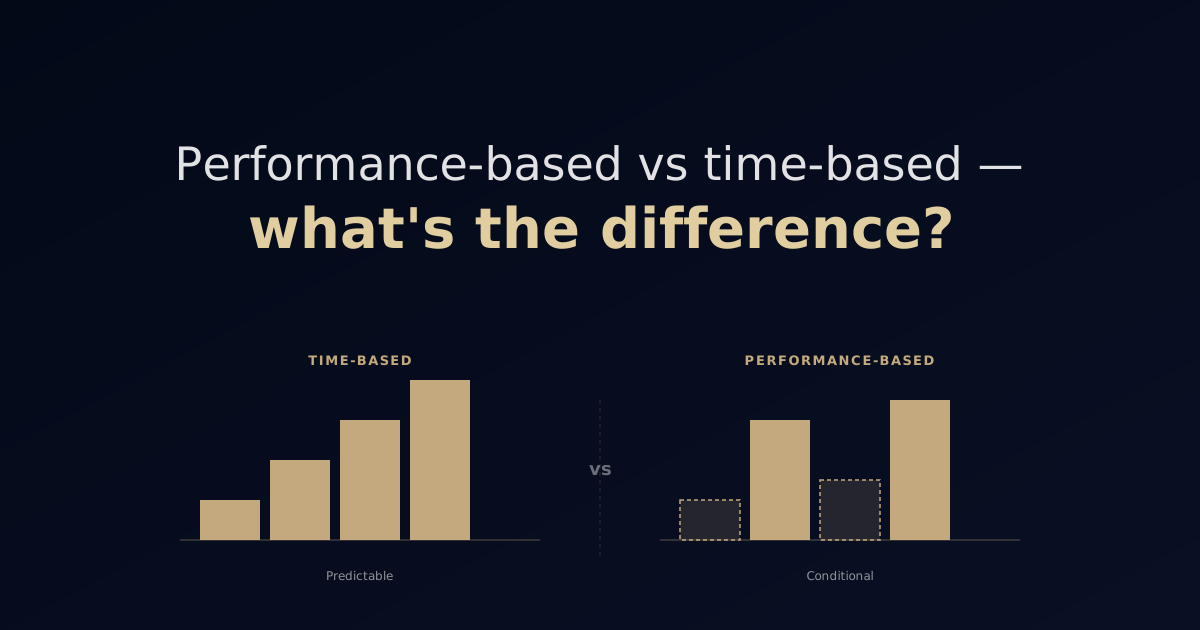
In time-based vesting, the only condition is staying employed for a certain period. You show up, do your job, cross the cliff, and shares vest on schedule regardless of how the business is performing.
This is what most large US tech companies use — Google, Amazon, Microsoft, Meta. The amount you receive is determined by the stock price on vest day, not by whether the company hit its revenue targets.
For financial planning purposes, time-based vesting is more predictable. You know when the shares will vest. You don't know what they'll be worth, but you know they'll arrive on schedule if you stay.
Performance-based Vesting: the Conditions
Performance-based vesting adds a second condition beyond time: the shares vest only if certain targets are met. Common performance metrics:
Revenue or ARR targets: The company must hit a specified revenue number. Stock price targets: The stock must reach or sustain a price above a threshold (common for executive grants). EBITDA or profitability milestones: The company must achieve a profitability level. Product or operational milestones: Launch a product, achieve a market position, complete an acquisition.
Some companies use a combination — you must both stay employed for four years and hit a performance target. Others use performance as a multiplier — you receive 0.5x to 2x of your grant depending on performance.
Where Performance Vesting Shows Up in India
Performance-based RSUs are less common at large US companies for regular employees, but they appear in a few specific contexts:
Pre-IPO companies: Indian startups and pre-IPO companies often tie vesting to liquidity events (IPO, acquisition) or revenue milestones, especially for senior employees.
Executive grants: At large public companies, executive-level RSUs (for VPs, C-suite) often have performance components alongside time-based components.
Freshworks pre-IPO period: Some Freshworks grants before the 2021 IPO had liquidity conditions, meaning shares only vested upon a qualifying liquidity event.
The Planning Challenge
With time-based vesting, you can estimate your RSU income for the next four years with reasonable confidence. With performance-based vesting, you can't.
The performance condition creates a binary outcome: full vesting, partial vesting, or zero vesting. You're not just uncertain about the stock price — you're uncertain about whether you'll receive any shares at all.
This has a direct implication: do not make major financial commitments based on performance-vested grants you haven't earned yet. A home loan, a large investment, a lifestyle change — if any of these are contingent on equity that hasn't cleared its performance conditions, you're taking on more risk than the face value of the grant suggests.
📊 TABLE: "Time-Based vs Performance-Based Vesting — Key Differences" [Insert here: comparison table] Feature | Time-based | Performance-based Vesting condition | Stay employed for vesting period | Stay + meet a performance target Predictability | High — date is fixed | Low — depends on company/stock performance Common users | Large US tech companies (Google, MSFT, Amazon) | Startups, executive grants, pre-IPO companies Financial planning | Can model future equity income | Cannot count on it until performance is confirmed Tax event | At vest date (when shares are delivered) | Same — at vest, once conditions are met
Questions to Ask Before Accepting a Performance-based Grant
If a grant you're being offered has performance conditions, ask:
1. What exactly are the performance conditions? 2. What's the measurement period and who determines whether targets are met? 3. What happens if conditions are partially met — do I get a partial grant? 4. What's the history of this grant type — have previous cohorts received their full grants? 5. Is there a floor — a minimum amount I receive even if targets aren't fully met?
The clearer the answers, the more you can include this equity in your financial planning with confidence.
How Rovia Can Help
If you're trying to figure out whether performance-based equity should be part of your financial plan, or if you have a mix of time-based and performance-based grants, Rovia can help you think through the realistic expected value — not the face value — and build a plan that doesn't depend on outcomes that aren't yet confirmed.


