If you're an Indian tech professional with US RSUs, there's a good chance you've spent time inside Fidelity, Morgan Stanley, E*TRADE, or Charles Schwab — not because you chose them, but because your employer did. These are the four platforms that most US companies use to administer stock grants, and your relationship with them started the day your first tranche vested.
The problem is that none of them were designed for you.
They were built for US residents, US tax situations, and US financial behaviour. When you're living in Bangalore, Hyderabad, or Pune — holding US equity, subject to Indian tax law, wanting to move or reinvest without an expensive round-trip through forex — the gaps in these platforms aren't edge cases. They're the entire experience.
This is a breakdown of how each platform handles the specific needs of Indian RSU holders, what transferring away from them actually involves, and what a better alternative looks like.
Fidelity RSU: India's most common frustration
Fidelity is the default broker for a large chunk of US tech companies — Walmart, Infosys, and hundreds of others use it to administer RSUs. Which means a lot of Indian engineers have a Fidelity account they didn't ask for and don't fully understand.
The tax labelling problem.
Fidelity labels any holding over 12 months as "Long Term." For a US resident, that's accurate — the IRS uses a 12-month threshold for long-term capital gains. But India's Income Tax Act uses a 24-month threshold for foreign-listed equity. That gap is not cosmetic. If you sell a holding at 18 months because Fidelity's UI tells you it's "Long Term," you'll pay short-term capital gains tax in India — potentially adding a significant and entirely preventable tax bill.
The interface problem.
Fidelity's platform is dense, cluttered, and clearly designed for an active US investor who already knows the terminology. Multiple users have reported needing to call Fidelity customer support just to perform basic operations — finding their cost basis, understanding their vesting schedule, initiating a transfer. For a platform that holds your salary, that's a significant failure.
The forex problem.
When you want to withdraw RSU proceeds to India, Fidelity routes the conversion through standard international wire transfer mechanisms. The spread on these conversions is rarely transparent and rarely favourable. Over multiple transactions across several years of vesting, this compounds into a meaningful amount of money lost to friction.
Morgan Stanley RSU India: built for executives, not engineers
Morgan Stanley's stock plan platform (formerly Shareworks, now part of Morgan Stanley at Work) is common at companies like Meta, Salesforce, and various financial services firms. It was originally designed for senior executives with complex equity structures — which is part of why it can feel overcomplicated for someone who just wants to understand their vesting schedule.
What it does reasonably well.
The reporting infrastructure is more sophisticated than Fidelity's — you can pull detailed grant histories and tax documents with less effort. For someone with multiple grant types (RSUs, NQSOs, ISOs), the consolidated view is genuinely useful.
Where it falls short for India.
Morgan Stanley's platform, like Fidelity's, provides US tax context by default. It has no India-specific tax guidance built in. The 24-month LTCG threshold, the applicability of TRC (Tax Residency Certificate) considerations, FEMA compliance for remittance — none of this is surfaced in the interface. You're expected to figure it out yourself or pay an advisor.
Withdrawal to India follows the same pattern as other legacy brokers: sell, convert, remit via SWIFT, absorb the forex spread. There's no mechanism to reinvest into other US assets without going through a separate US brokerage account.
E*TRADE RSU India: the most feature-heavy, but not for you
E*TRADE (now part of Morgan Stanley) handles RSUs for companies including Amazon, Microsoft, and Dell. Its stock plan interface — E*TRADE Corporate Services — is one of the more capable platforms in the legacy broker category.
The UI is better.
E*TRADE's dashboard is cleaner than Fidelity's and surfaces vesting information more intuitively. For someone who just wants to see what's vesting when, it's less hostile.
The tax problem remains.
E*TRADE's tax reporting is designed for US residents and US tax obligations. It calculates supplemental income at vest correctly for Form W-2 purposes — but it cannot tell you what your Indian tax liability looks like on a sale, what the holding period is under Indian law, or how to structure a sale to minimise your combined US and Indian tax burden.
The India remittance problem remains.
Getting money from E*TRADE to an Indian bank account requires a sale, a SWIFT wire, a forex conversion, and anywhere from 3 to 7 business days. Each step costs something. There's no native mechanism for redirecting proceeds into global investments without that round-trip.
Charles Schwab RSU India: the quieter option, same core gaps
Schwab acquired TD Ameritrade in 2020 and has been absorbing its infrastructure since. Some companies use Schwab's stock plan services — Schwab Stock Plan Services — particularly in sectors like healthcare and finance.
What Schwab does differently.
Schwab's customer service has historically been rated higher than Fidelity's, and the platform has a cleaner interface for straightforward tasks. If you need to exercise options or initiate a basic sale, the process is reasonably well-documented.
The India-specific gaps are the same.
No 24-month LTCG guidance, no India tax modelling, no forex-free reinvestment pathway. The Fidelity vs Schwab RSU comparison, from the perspective of an Indian user, largely comes down to UI preference. The structural limitations are identical — both are US-first platforms that route Indian users through the same friction points.
How to transfer RSUs from Fidelity (or any legacy broker)
If you've decided to move your RSUs off a legacy platform, the process is broadly similar regardless of which broker you're leaving.
Step 1: Understand what you're transferring. RSUs that have vested are simply shares — they can be transferred like any equity position. Unvested RSUs cannot be transferred; they're a contractual promise from your employer, not a tradeable asset. Make sure you know which portion of your holdings is vested before initiating anything.
Step 2: Trigger a Direct Registration or ACATS transfer. The standard mechanism for moving equity between US brokers is ACATS (Automated Customer Account Transfer Service). Most receiving brokers will initiate this on your behalf. The process typically takes 5–7 business days. Shares move in-kind — you don't have to sell to transfer, which means you don't trigger a tax event on the transfer itself.
Step 3: Preserve your cost basis records. This is the most commonly overlooked step. Your cost basis — the price at which your RSUs were treated as income at vest — is critical for calculating capital gains correctly. Transfer it carefully; some platforms handle this poorly, and arriving at a new broker with an incorrect cost basis creates tax headaches later.
Step 4: Re-evaluate your tax situation post-transfer. The act of transferring doesn't change your tax obligations, but it's a natural inflection point to understand where you stand: how long each lot has been held, what your India-side liability looks like on a hypothetical sale, and whether you've crossed the 24-month threshold that determines your LTCG rate in India.
The 24-month rule: the most important thing most RSU holders in India don't know
Under the Indian Income Tax Act, gains on the sale of foreign-listed equity are classified as long-term if the holding period exceeds 24 months. Short-term gains (held less than 24 months) are taxed at your income tax slab rate — which for most senior tech employees is 30%.
Following the Indian Finance Act 2024 (effective July 2024), long-term gains on foreign-listed equity are taxed at 12.5% without indexation benefit — a change from the earlier 20% with indexation treatment. Short-term gains remain taxed at your applicable income tax slab rate, which for most senior tech employees is 30%.
The gap between 12 months and 24 months is the silent trap. Fidelity, E*TRADE, Schwab, and Morgan Stanley all use the US 12-month threshold in their UI. None of them flag this for Indian users. If you sell at 18 months thinking you're in the long-term category — because every label in your broker's interface says so — you've just moved from a 12.5% rate to a 30% rate on what may be a significant sum.
Note: Indian capital gains tax rules for foreign equity are subject to change. The rates above reflect the Finance Act 2024 amendments. Consult a qualified CA for advice specific to your situation before making any sale decision.
What an alternative to Fidelity actually looks like for Indian users
The platforms above share a common architecture: built in the US, for the US, with India treated as an afterthought (or not treated at all).
Rovia is built from the opposite assumption. It's a wealth management platform designed specifically for global tech professionals — engineers, founders, and executives living in India, Singapore, Europe, and Australia who hold US RSUs as part of their compensation.
The practical differences:
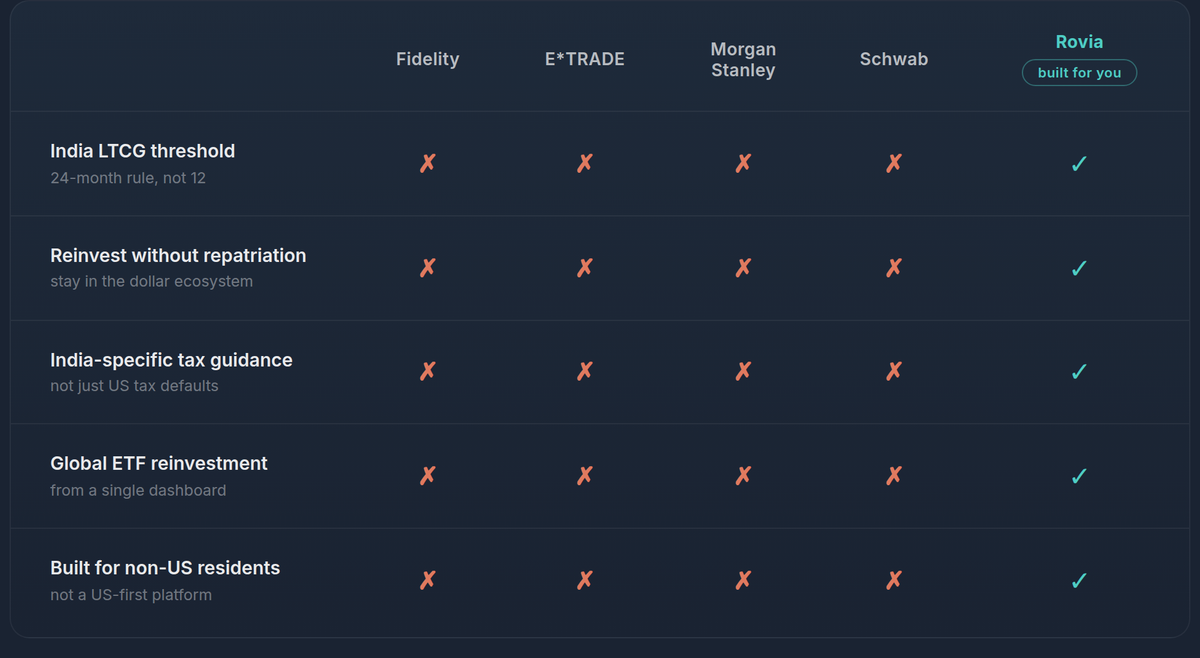
Tax thresholds that reflect Indian law, not US law. Rovia is built to surface India-specific tax context — including the 24-month LTCG holding period that legacy US platforms don't show. Rather than defaulting to the US 12-month label, the platform is designed to help you understand where each lot actually stands under Indian tax rules before you make any decision to sell.
Reinvestment without repatriation. When you sell RSUs on Rovia, you can redirect the proceeds into other US stocks or global ETFs directly — without the standard repatriation round-trip that legacy brokers require. The money stays in the dollar ecosystem and gets redeployed, rather than going through a conversion, a SWIFT transfer, and a re-entry into the market days later.
A platform built for your situation. The dashboard is designed for the specific decisions an Indian RSU holder makes — when to sell, how much to hold, how to diversify without concentrating into Indian markets, how to think about the combined US and India tax picture.
RSU broker comparison
The bottom line
If your company uses Fidelity, E*TRADE, Morgan Stanley, or Schwab to administer your RSUs, you don't need to leave them immediately — but you should understand what they can and can't tell you. They can tell you what you own and what it's worth. They cannot tell you what your Indian tax liability is, when your long-term holding period actually kicks in under Indian law, or how to reinvest without losing a percentage to forex on every transaction.
For that, you need a platform that was actually built for you.
Request early access to Rovia →
Disclaimer: This article is for informational purposes only and does not constitute financial, tax, or investment advice. Platform comparisons are based on publicly available information at the time of writing and may not reflect the most current features, fees, or terms of the platforms mentioned. Tax rules, rates, and thresholds are subject to change — the information above reflects our understanding as of the date of publication and should not be relied upon as a substitute for advice from a qualified Chartered Accountant or financial advisor. Please consult a professional before making any decisions regarding your RSUs or investment portfolio.


